
Ch. 2 - Acids and Bases; Functional Groups
Wade - Organic Chemistry 9th Edition
Wade9th EditionOrganic ChemistryISBN: 9780135213728Not the one you use?Change textbook
Chapter 2, Problem 22e

Choose the more basic member of each pair of isomers, and show why the base you chose is more basic.
e.

Verified step by step guidance
1
Identify the functional groups present in each isomer. Both isomers have a cyano group (C≡N) and a phenoxide ion (O⁻) attached to a benzene ring.
Consider the position of the cyano group relative to the phenoxide ion. In the first isomer, the cyano group is in the para position, while in the second isomer, it is in the ortho position.
Evaluate the electron-withdrawing effect of the cyano group. The cyano group is a strong electron-withdrawing group due to its electronegative nitrogen and triple bond, which can stabilize negative charge through resonance and inductive effects.
Analyze the resonance structures. In the para isomer, the negative charge on the oxygen can be delocalized over the benzene ring and further stabilized by the cyano group through resonance. In the ortho isomer, the proximity of the cyano group may lead to steric hindrance, affecting resonance stabilization.
Conclude which isomer is more basic. The para isomer is more basic because the negative charge on the oxygen is better stabilized by resonance with the cyano group, making it less likely to accept a proton compared to the ortho isomer.

Verified video answer for a similar problem:

This video solution was recommended by our tutors as helpful for the problem above.
Video duration:
11m
Was this helpful?

Key Concepts

Here are the essential concepts you must grasp in order to answer the question correctly.

Basicity in Organic Chemistry

Basicity refers to the ability of a compound to accept protons (H+ ions). In organic chemistry, the basicity of a molecule is often influenced by the availability of lone pairs of electrons on atoms like nitrogen or oxygen, which can accept protons. The more available these lone pairs are, the stronger the base. Factors such as resonance, inductive effects, and hybridization can affect this availability.
Recommended video:
Guided course
00:56
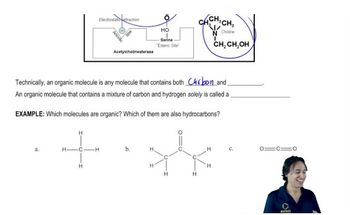
What is an organic molecule?

Resonance Effects on Basicity

Resonance involves the delocalization of electrons across a molecule, which can stabilize or destabilize a base. In the context of basicity, if the lone pair of electrons on a basic atom is involved in resonance, it is less available to accept protons, reducing basicity. Conversely, if resonance stabilizes the conjugate acid, the base is stronger. Analyzing resonance structures helps determine the electron availability and thus the basicity.
Recommended video:
Guided course
03:32
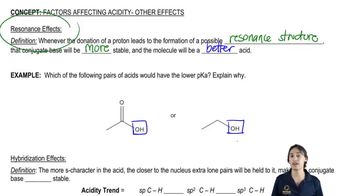
Understanding Resonance Effects

Inductive Effects on Basicity

Inductive effects involve the transmission of charge through a chain of atoms in a molecule, affecting electron density. Electron-withdrawing groups can decrease basicity by pulling electron density away from the basic site, making it less able to accept protons. Conversely, electron-donating groups increase basicity by pushing electron density towards the basic site. Understanding these effects is crucial for predicting the relative basicity of isomers.
Recommended video:
Guided course
01:47
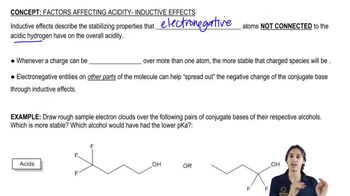
Understanding the Inductive Effect.
Related Practice
Textbook Question

In the following acid–base reactions,

1. draw Lewis structures of the reactants and the products.

2. determine which species are acting as electrophiles (acids) and which are acting as nucleophiles (bases).

3. use the curved-arrow formalism to show the movement of electron pairs in these ­reactions, as well as the imaginary movement in the resonance hybrids of the products.

4. indicate which reactions are best termed Brønsted–Lowry acid–base reactions.

(a)

1499
views
Textbook Question

In the following acid–base reactions,

1. draw Lewis structures of the reactants and the products.

2. determine which species are acting as electrophiles (acids) and which are acting as nucleophiles (bases).

3. use the curved-arrow formalism to show the movement of electron pairs in these ­reactions, as well as the imaginary movement in the resonance hybrids of the products.

4. indicate which reactions are best termed Brønsted–Lowry acid–base reactions.

(b)

1407
views
Textbook Question

Choose the more basic member of each pair of isomers, and show why the base you chose is more basic.

c.

d.

791
views
Textbook Question

Choose the more basic member of each pair of isomers, and show why the base you chose is more basic.

(a)

(b)

1168
views
Textbook Question

Classify the following hydrocarbons, and draw a Lewis structure for each one. A compound may fit into more than one of the following classifications:

alkane

alkene

alkyne

cycloalkane

cycloalkene

cycloalkyne

aromatic

hydrocarbon

a. (CH3CH2)2CHCH(CH3)2

b. CH3CHCHCH2CH3

c.. CH3CCCH2CH2CH3

1073
views
Textbook Question

Choose the more acidic member of each pair of isomers, and show why the acid you chose is more acidic.

(f)

(g)

601
views