
Textbook Question
Consider the following compounds that vary from nearly nonacidic to strongly acidic. Draw the conjugate bases of these compounds, and explain why the acidity increases so dramatically with substitution by nitro groups.
839
views


 Verified step by step guidance
 02:49
02:49
 04:32
04:32 1:30
1:30Consider the following compounds that vary from nearly nonacidic to strongly acidic. Draw the conjugate bases of these compounds, and explain why the acidity increases so dramatically with substitution by nitro groups.
Methyllithium (CH3Li) is often used as a base in organic reactions.
b. What is the conjugate acid of CH3Li? Would you expect CH3Li to be a strong base or a weak base?
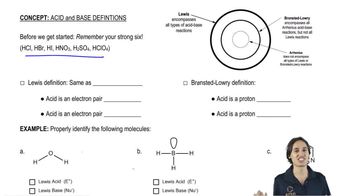
Label the reactants in these acid–base reactions as Lewis acids (electrophiles) or Lewis bases (nucleophiles). Use curved arrows to show the movement of electron pairs in the reactions.
(d)
Label the reactants in these acid–base reactions as Lewis acids (electrophiles) or Lewis bases (nucleophiles). Use curved arrows to show the movement of electron pairs in the reactions.
i.
Label the reactants in these acid–base reactions as Lewis acids (electrophiles) or Lewis bases (nucleophiles). Use curved arrows to show the movement of electron pairs in the reactions.
(c)
Label the reactants in these acid–base reactions as Lewis acids (electrophiles) or Lewis bases (nucleophiles). Use curved arrows to show the movement of electron pairs in the reactions.
(a)