Ch. 2 - Acids and Bases; Functional Groups
Wade - Organic Chemistry 9th Edition
Wade9th EditionOrganic ChemistryISBN: 9780135213728Not the one you use?Change textbook
Chapter 2, Problem 42g

Predict the products of the following acid–base reactions.
(g) HCOOH + CH3O

Verified step by step guidance
1
Identify the acid and the base in the reaction. In this case, HCOOH (formic acid) is the acid, and CH3O- (methoxide ion) is the base.
Determine the conjugate base of the acid. The conjugate base of HCOOH is HCOO- (formate ion), which is formed by the loss of a proton (H+).
Determine the conjugate acid of the base. The conjugate acid of CH3O- is CH3OH (methanol), which is formed by the gain of a proton (H+).
Write the products of the reaction using the conjugate acid and base identified. The products are HCOO- and CH3OH.
Verify the reaction by checking the direction of equilibrium. Since methanol is a weaker acid than formic acid, the equilibrium will favor the formation of the weaker acid and base, confirming the products as HCOO- and CH3OH.

Verified video answer for a similar problem:

This video solution was recommended by our tutors as helpful for the problem above.
Video duration:
2m
Was this helpful?

Key Concepts

Here are the essential concepts you must grasp in order to answer the question correctly.

Acid-Base Reactions

Acid-base reactions involve the transfer of protons (H+) between reactants. In this context, HCOOH (formic acid) acts as an acid, donating a proton, while CH3O- (methoxide ion) acts as a base, accepting a proton. Understanding the roles of acids and bases is crucial for predicting the products of such reactions.
Recommended video:
Guided course
02:49
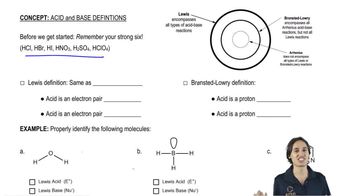
The Lewis definition of acids and bases.

Conjugate Acid-Base Pairs

In an acid-base reaction, the acid and base transform into their respective conjugate base and conjugate acid. For HCOOH, the conjugate base is HCOO- (formate ion), and for CH3O-, the conjugate acid is CH3OH (methanol). Recognizing these pairs helps in identifying the products formed after the proton transfer.
Recommended video:
2:56
Base Pairing Concept 1

Equilibrium in Acid-Base Reactions

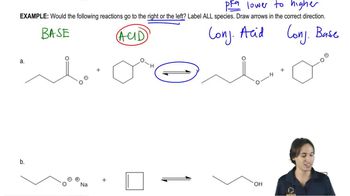
Acid-base reactions often reach an equilibrium state, where the forward and reverse reactions occur at the same rate. The position of equilibrium depends on the relative strengths of the acids and bases involved. In this reaction, the equilibrium will favor the side with the weaker acid and base, which can be determined by comparing pKa values.
Recommended video:
Guided course
04:00
Determining Acid/Base Equilibrium