Consider the following compounds that vary from nearly nonacidic to strongly acidic. Draw the conjugate bases of these compounds, and explain why the acidity increases so dramatically with substitution by nitro groups.
Ch. 2 - Acids and Bases; Functional Groups
Chapter 2, Problem 47a
The following compounds can all react as acids.

a. For each compound, show its conjugate base. Show any resonance forms if applicable.
Verified step by step guidance1
Identify the acidic hydrogen in each compound. For carboxylic acids (e.g., CH₃COOH), the acidic hydrogen is the one attached to the oxygen in the hydroxyl group.
For each compound, remove the acidic hydrogen to form the conjugate base. For example, removing the hydrogen from CH₃COOH results in CH₃COO⁻.
Draw the conjugate base for each compound. For CH₃CONH₂, removing the hydrogen from the amide group results in CH₃CONH⁻.
Consider resonance stabilization for each conjugate base. For example, the acetate ion (CH₃COO⁻) has resonance forms where the negative charge is delocalized between the two oxygen atoms.
Repeat the process for each compound, ensuring to show all possible resonance forms for the conjugate bases, such as for CH₃SOH, CH₃SO₂OH, and FSO₂OH.

Verified video answer for a similar problem:
This video solution was recommended by our tutors as helpful for the problem above.
Video duration:
11mWas this helpful?
Key Concepts
Here are the essential concepts you must grasp in order to answer the question correctly.
Acid-Base Chemistry
Acid-base chemistry involves the transfer of protons (H+) between molecules. An acid is a substance that can donate a proton, while a base is a substance that can accept a proton. In the context of the given compounds, each can donate a proton to form its conjugate base, which is the species remaining after the acid has donated a proton.
Recommended video:
Guided course
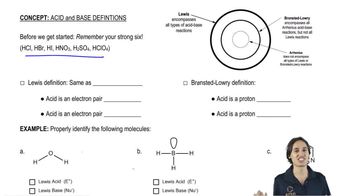
The Lewis definition of acids and bases.
Conjugate Base
The conjugate base of an acid is formed when the acid donates a proton. It is crucial to understand the stability of the conjugate base, as it influences the acidity of the original compound. For example, resonance stabilization of the conjugate base can enhance the acidity of the parent acid by delocalizing the negative charge over multiple atoms.
Recommended video:
Guided course
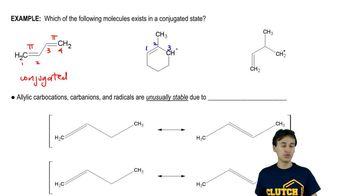
Conjugated states
Resonance Structures
Resonance structures are different ways of drawing the same molecule, showing the delocalization of electrons. They are important for understanding the stability of conjugate bases, as resonance can distribute the negative charge over several atoms, stabilizing the conjugate base. In the given compounds, identifying possible resonance forms helps predict the relative acidity of each compound.
Recommended video:
Guided course
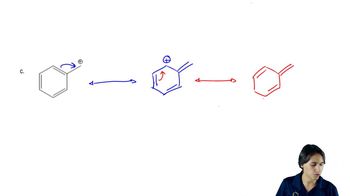
Drawing Resonance Structures
Related Practice
Textbook Question
839
views
Textbook Question
The following compounds can all react as bases.
a. For each compound, show its conjugate acid. Show any resonance forms if applicable.
926
views
Textbook Question
The following compounds can all react as bases.
c. Rank the original compounds in order, from strongest base to weakest base.
1759
views
Textbook Question
Methyllithium (CH3Li) is often used as a base in organic reactions.
b. What is the conjugate acid of CH3Li? Would you expect CH3Li to be a strong base or a weak base?
3394
views
Textbook Question
The following compounds can all react as acids.
b. Rank the conjugate bases in the order you would predict, from most stable to least stable.
878
views
Textbook Question
The following compounds can all react as bases.
b. Rank the conjugate acids in the order you would predict, from most stable to least stable.
623
views