Ch.10 - Structure and Synthesis of Alcohols
Wade - Organic Chemistry 9th Edition
Wade9th EditionOrganic ChemistryISBN: 9780135213728Not the one you use?Change textbook
Chapter 10, Problem 42d

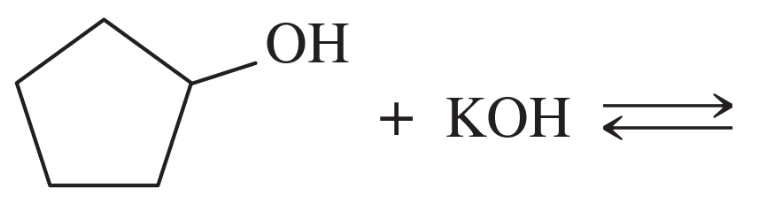
Complete the following acid–base reactions. In each case, indicate whether the equilibrium favors the reactants or the products, and explain your reasoning.
(d)

Verified step by step guidance
1
Step 1: Identify the acid and base in the reaction. In this case, cyclopentanol (C5H9OH) acts as the acid because it can donate a proton (H+), and KOH acts as the base because it can accept a proton.
Step 2: Write the products of the acid-base reaction. Cyclopentanol will lose a proton to form cyclopentoxide (C5H9O−), and KOH will donate its hydroxide ion (OH−) to form water (H2O). The reaction can be represented as: C5H9OH + OH− ⇌ C5H9O− + H2O.
Step 3: Determine the direction of equilibrium. The equilibrium position depends on the relative acidity of cyclopentanol and water. Cyclopentanol has a pKa of approximately 16, while water has a pKa of 15.7. Since water is slightly more acidic than cyclopentanol, the equilibrium will favor the formation of cyclopentanol and hydroxide ions (reactants).
Step 4: Explain the reasoning. The equilibrium favors the side with the weaker acid and base. In this case, cyclopentanol (weaker acid) and hydroxide ion (weaker base) are favored over cyclopentoxide and water.
Step 5: Conclude the analysis. The equilibrium favors the reactants (cyclopentanol and KOH) because the acid (cyclopentanol) is weaker than water, and the base (OH−) is stronger than cyclopentoxide.

Verified video answer for a similar problem:

This video solution was recommended by our tutors as helpful for the problem above.
Video duration:
5m
Was this helpful?

Key Concepts

Here are the essential concepts you must grasp in order to answer the question correctly.

Acid-Base Reactions

Acid-base reactions involve the transfer of protons (H+) between reactants. In this context, the hydroxyl group (OH-) acts as a weak acid, while KOH, a strong base, dissociates to provide hydroxide ions (OH-). Understanding the nature of the acids and bases involved is crucial for predicting the direction of the equilibrium.
Recommended video:
Guided course
02:49
The Lewis definition of acids and bases.

Equilibrium Position

The position of equilibrium in a chemical reaction indicates whether the reactants or products are favored. This can be influenced by factors such as the strength of the acids and bases involved, the stability of the resulting products, and the concentration of reactants and products. In this case, the equilibrium will favor the side with the weaker acid and base.
Recommended video:
2:49
Reactions at the Allylic Position Concept 5

Strength of Acids and Bases

The strength of an acid or base is determined by its ability to donate or accept protons. Strong acids completely dissociate in solution, while weak acids do not. In this reaction, KOH is a strong base, which will drive the reaction towards the formation of water and the corresponding alkoxide, favoring the products over the reactants.
Recommended video:
2:50
Acid-Base Catalysis Concept 3