Ch.10 - Structure and Synthesis of Alcohols
Wade - Organic Chemistry 9th Edition
Wade9th EditionOrganic ChemistryISBN: 9780135213728Not the one you use?Change textbook
Chapter 10, Problem 49

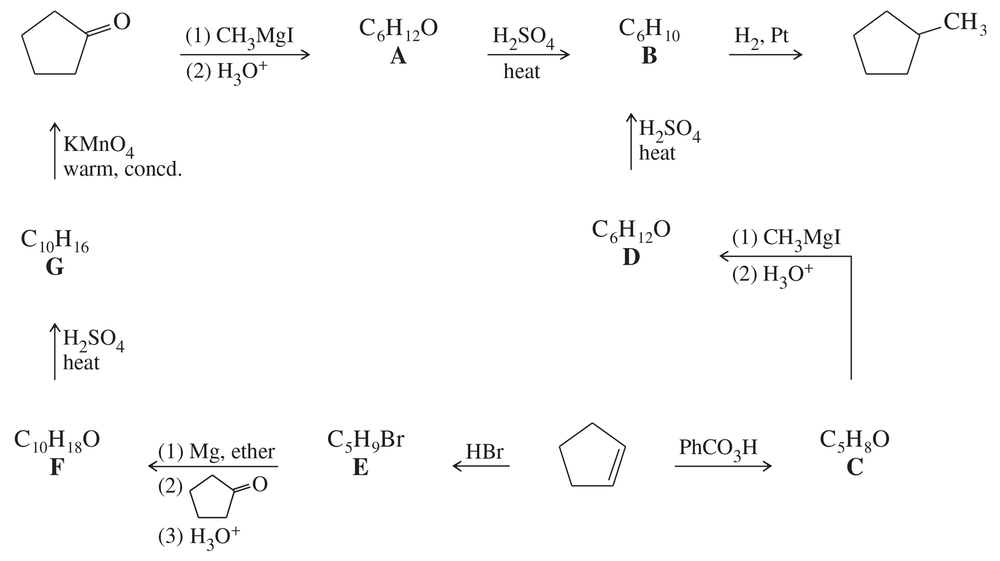
Determine the structures of compounds A through G, including stereochemistry where appropriate.

Verified step by step guidance
1
Step 1: Analyze the first reaction. The starting material is cyclohexene, which reacts with perbenzoic acid (PhCO3H). This is an epoxidation reaction, where the double bond in cyclohexene reacts with the peracid to form an epoxide. Compound A is cyclohexene oxide.
Step 2: Examine the second reaction. Compound A (cyclohexene oxide) reacts with methylmagnesium bromide (CH3MgBr), a Grignard reagent, followed by acid workup (H3O+). The Grignard reagent attacks the less sterically hindered carbon of the epoxide, opening the ring and forming an alcohol. Compound B is 1-methylcyclohexanol.
Step 3: Consider the third reaction. Compound B (1-methylcyclohexanol) undergoes dehydration in the presence of concentrated sulfuric acid (H2SO4) and heat (Δ). This elimination reaction removes water to form an alkene. Compound C is 1-methylcyclohexene.
Step 4: Analyze the final reaction. Compound C (1-methylcyclohexene) undergoes catalytic hydrogenation in the presence of hydrogen gas (H2) and platinum (Pt). This reaction reduces the double bond in the alkene to form a saturated hydrocarbon. The final product is methylcyclohexane.
Step 5: Ensure stereochemistry is considered where appropriate. In this sequence, stereochemistry is relevant during the epoxide opening and Grignard addition, as the attack occurs at the less hindered side of the epoxide. The final product, methylcyclohexane, does not have stereochemical concerns as it is a symmetric saturated hydrocarbon.

Verified video answer for a similar problem:

This video solution was recommended by our tutors as helpful for the problem above.
Video duration:
9m
Was this helpful?

Key Concepts

Here are the essential concepts you must grasp in order to answer the question correctly.

Grignard Reagents

Grignard reagents are organomagnesium compounds that react with electrophiles to form carbon-carbon bonds. In this reaction scheme, CH3MgBr acts as a nucleophile, attacking the electrophilic carbon of the carbonyl group in compound A, leading to the formation of a tertiary alcohol in compound B.
Recommended video:
Guided course
02:12
Carbonation of Grignard Reagents

Acid-Catalyzed Reactions

Acid-catalyzed reactions involve the use of an acid to facilitate the conversion of reactants into products. In this case, sulfuric acid (H2SO4) is used to promote the dehydration of the alcohol in compound B to form an alkene in compound C, highlighting the importance of acid in organic transformations.
Recommended video:
Guided course
03:09
Acid Catalyzed

Stereochemistry

Stereochemistry refers to the spatial arrangement of atoms in molecules and the impact of this arrangement on chemical properties and reactions. Understanding stereochemistry is crucial for determining the correct structure of compounds A through G, especially when dealing with chiral centers or geometric isomers that may arise during the synthesis.
Recommended video:
1:38
Polymer Stereochemistry Concept 1
Related Practice
Textbook Question

Propose structures for intermediates and products (A) through (D)

668
views

Textbook Question

Compound A (C7H11Br) is treated with magnesium in ether to give B (C7H11MgBr), which reacts violently with D2O to give 1-methylcyclohexene with a deuterium atom on the methyl group (C). Reaction of B with acetone (CH3COCH3) followed by hydrolysis gives D (C10H18O). Heating D with concentrated H2SO4 gives E (C10H16), which decolorizes two equivalents of Br2 to give F (C10H16Br4). E undergoes hydrogenation with excess H2 and a Pt catalyst to give isobutylcyclohexane. Determine the structures of compounds A through F, and show your reasoning throughout.

1197
views
Textbook Question

Vinyl alcohols are generally unstable, quickly isomerizing to carbonyl compounds. Propose mechanisms for the following isomerizations.

(c)

694
views
Textbook Question

Propose structures for intermediates and products (A) through (D).

801
views
Textbook Question

Grignard reagents react slowly with oxetane to produce primary alcohols. Propose a mechanism for this reaction, and suggest why oxetane reacts with Grignard reagents even though most ethers do not.

750
views
Textbook Question

Many hunting dogs enjoy standing nose-to-nose with a skunk while barking furiously, oblivious to the skunk spray directed toward them. One moderately effective way of lessening the amount of odor is to wash the dog in a bath containing dilute hydrogen peroxide, sodium bicarbonate, and some mild dish detergent. Use chemical reactions to describe how this mixture helps to remove the skunk spray from the dog. The two major components of skunk oil are 3-methylbutane-1-thiol and but-2-ene-1-thiol.

989
views