Ch.10 - Structure and Synthesis of Alcohols
Wade - Organic Chemistry 9th Edition
Wade9th EditionOrganic ChemistryISBN: 9780135213728Not the one you use?Change textbook
Chapter 10, Problem 36n

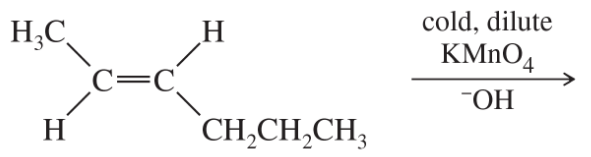
Draw the organic products you would expect to isolate from the following reactions (after hydrolysis).
(n)

Verified step by step guidance
1
Step 1: Analyze the reaction conditions. The reagent KMnO₄ under cold, dilute conditions is used for the oxidation of alkenes to form diols (glycols) via syn-dihydroxylation. This reaction adds hydroxyl (-OH) groups to the double bond in a syn fashion.
Step 2: Identify the structure of the starting material. The molecule contains a double bond (C=C) in the structure, which is the reactive site for KMnO₄ under these conditions.
Step 3: Predict the product formation. The double bond will undergo syn-dihydroxylation, meaning two hydroxyl groups (-OH) will be added to the carbons involved in the double bond. The stereochemistry of the addition will be syn, meaning both hydroxyl groups will be added to the same face of the molecule.
Step 4: Draw the product structure. For the given alkene, add -OH groups to the two carbons of the double bond. Ensure the stereochemistry reflects syn addition (both -OH groups on the same side of the molecule).
Step 5: Verify the product. Confirm that the resulting molecule is a vicinal diol (two hydroxyl groups on adjacent carbons) and that no other functional groups or parts of the molecule are altered under these reaction conditions.

Verified video answer for a similar problem:

This video solution was recommended by our tutors as helpful for the problem above.
Video duration:
2m
Was this helpful?

Key Concepts

Here are the essential concepts you must grasp in order to answer the question correctly.

Alkene Hydroxylation

Alkene hydroxylation is a chemical reaction where alkenes react with oxidizing agents, such as cold, dilute KMnO4, to form glycols. This reaction typically adds hydroxyl (-OH) groups across the double bond of the alkene, resulting in the formation of vicinal diols. Understanding this process is crucial for predicting the products of the given reaction.
Recommended video:
2:09
Alkene Metathesis Concept 1

Regioselectivity

Regioselectivity refers to the preference of a chemical reaction to yield one structural isomer over others when multiple possibilities exist. In the case of alkene hydroxylation, the regioselectivity is influenced by the stability of the carbocation intermediates and steric factors, which can affect the distribution of products formed during the reaction.
Recommended video:
Guided course
05:09
Heck Reaction

Stereochemistry of Products

Stereochemistry involves the spatial arrangement of atoms in molecules and how this affects their chemical properties. In the context of alkene reactions, the formation of diols can lead to different stereoisomers, such as cis and trans forms. Recognizing the stereochemical outcomes is essential for accurately depicting the products after hydrolysis.
Recommended video:
1:38
Polymer Stereochemistry Concept 1