Ch.10 - Structure and Synthesis of Alcohols
Wade - Organic Chemistry 9th Edition
Wade9th EditionOrganic ChemistryISBN: 9780135213728Not the one you use?Change textbook
Chapter 10, Problem 23c,d

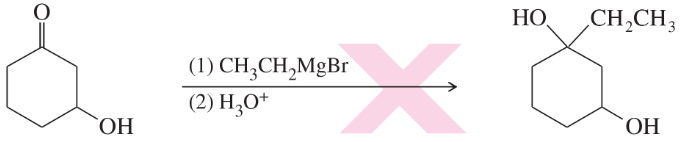
Point out the flaws in the following incorrect Grignard syntheses.
(c)
(d)

Verified step by step guidance
1
Step 1: Analyze the reaction in (c). The Grignard reagent, cyclohexylmagnesium bromide (C6H11MgBr), is reacting with acetone (CH3COCH3) under acidic conditions (H3O+). The expected product should involve the addition of the Grignard reagent to the carbonyl group of acetone, forming a tertiary alcohol. However, the product shown is incorrect.
Step 2: Identify the flaw in (c). The product depicted has a tertiary alcohol with an incorrect alkyl group attached to the carbon bearing the hydroxyl group. The Grignard reagent adds the cyclohexyl group to the carbonyl carbon, not the tert-butyl group shown in the product.
Step 3: Analyze the reaction in (d). The starting material is a cyclic ketone with a hydroxyl group (a hydroxy ketone). The Grignard reagent, ethylmagnesium bromide (CH3CH2MgBr), is expected to react with the ketone group, followed by acidic workup (H3O+). The product shown is incorrect.
Step 4: Identify the flaw in (d). The product depicted has two hydroxyl groups, one of which is attached to the carbon that originally had the ketone group. This is not possible because the Grignard reagent reacts with the ketone to form an alcohol, but it cannot introduce a second hydroxyl group at the same carbon.
Step 5: Conclude the analysis. In both cases, the Grignard reagent reacts with the carbonyl group to form an alcohol, but the products shown are inconsistent with the expected mechanism of Grignard reactions. The errors involve incorrect structural representations of the final products.

Verified video answer for a similar problem:

This video solution was recommended by our tutors as helpful for the problem above.
Video duration:
5m
Was this helpful?

Key Concepts

Here are the essential concepts you must grasp in order to answer the question correctly.

Grignard Reagents

Grignard reagents are organomagnesium compounds that are highly reactive and used in organic synthesis to form carbon-carbon bonds. They are created by reacting an alkyl or aryl halide with magnesium metal in an anhydrous ether solvent. Understanding their reactivity and the conditions required for their formation is crucial for analyzing any synthetic pathway involving them.
Recommended video:
Guided course
02:12
Carbonation of Grignard Reagents

Nucleophilic Addition

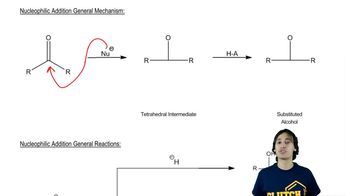
Nucleophilic addition is a fundamental reaction mechanism in organic chemistry where a nucleophile attacks an electrophilic carbon atom, leading to the formation of a new bond. In the context of Grignard reactions, the Grignard reagent acts as a nucleophile, attacking carbonyl compounds to form alcohols. Recognizing the role of nucleophiles and electrophiles is essential for identifying flaws in synthetic routes.
Recommended video:
Guided course
08:27
Nucleophilic Addition

Reaction Conditions

The reaction conditions, including solvent choice, temperature, and the presence of moisture, are critical in organic reactions, particularly with Grignard reagents, which are sensitive to water. Any moisture can lead to the hydrolysis of Grignard reagents, rendering them ineffective. Understanding the importance of maintaining anhydrous conditions is vital for evaluating the success of Grignard syntheses.
Recommended video:
1:18
EAS Reactions of Pyridine Example 1