Ch.10 - Structure and Synthesis of Alcohols
Wade - Organic Chemistry 9th Edition
Wade9th EditionOrganic ChemistryISBN: 9780135213728Not the one you use?Change textbook
Chapter 10, Problem 35b

Predict which member of each group is most soluble in water, and explain the reasons for your predictions.
b. chlorocyclohexane, cyclohexanol, or cyclohexane-1,2-diol

Verified step by step guidance
1
Step 1: Analyze the functional groups present in each compound. Chlorocyclohexane contains a chlorine atom, cyclohexanol contains one hydroxyl (-OH) group, and cyclohexane-1,2-diol contains two hydroxyl (-OH) groups.
Step 2: Understand the solubility trends in water. Water is a polar solvent, and compounds with polar functional groups (such as hydroxyl groups) are more likely to form hydrogen bonds with water, increasing their solubility.
Step 3: Compare the polarity of the functional groups. The hydroxyl group (-OH) is highly polar and can form hydrogen bonds with water, whereas the chlorine atom in chlorocyclohexane is less polar and cannot form hydrogen bonds as effectively.
Step 4: Consider the number of hydroxyl groups. Cyclohexane-1,2-diol has two hydroxyl groups, which can form more hydrogen bonds with water compared to cyclohexanol, which has only one hydroxyl group.
Step 5: Predict the solubility order based on the ability to form hydrogen bonds. Cyclohexane-1,2-diol is expected to be the most soluble in water due to its two hydroxyl groups, followed by cyclohexanol with one hydroxyl group, and finally chlorocyclohexane, which has the least polar functional group.

Verified video answer for a similar problem:

This video solution was recommended by our tutors as helpful for the problem above.
Video duration:
2m
Was this helpful?

Key Concepts

Here are the essential concepts you must grasp in order to answer the question correctly.

Polarity and Solubility

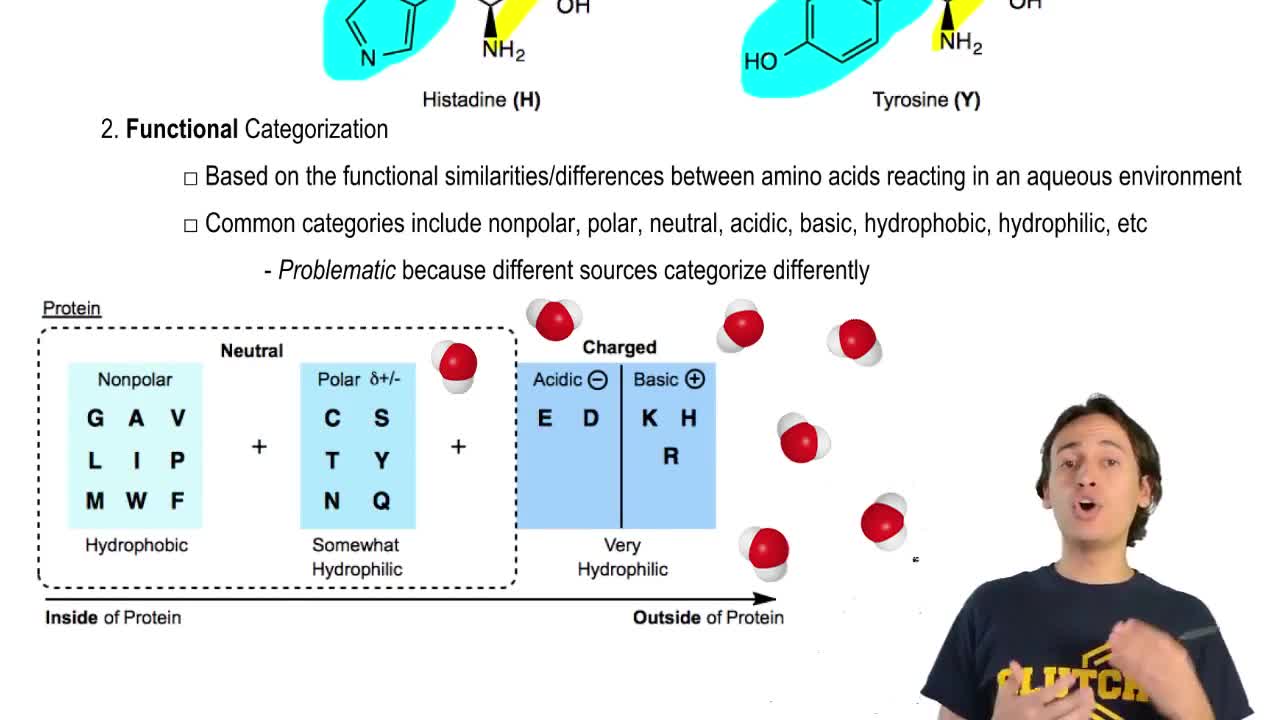
Polarity refers to the distribution of electrical charge over the atoms in a molecule. Polar molecules, which have a significant difference in electronegativity between atoms, tend to dissolve well in polar solvents like water. Understanding the polarity of the compounds in question is crucial for predicting their solubility in water.
Recommended video:
Guided course
07:13
Functional Classification

Hydrogen Bonding

Hydrogen bonding occurs when a hydrogen atom covalently bonded to a highly electronegative atom (like oxygen) interacts with another electronegative atom. Compounds capable of forming hydrogen bonds with water, such as alcohols, are generally more soluble in water. Recognizing which compounds can form these bonds is essential for solubility predictions.
Recommended video:
Guided course
00:48
The definition of hydrogenation.

Functional Groups

Functional groups are specific groups of atoms within molecules that are responsible for the characteristic chemical reactions of those molecules. In this case, the presence of hydroxyl (-OH) groups in cyclohexanol and cyclohexane-1,2-diol enhances their solubility in water compared to chlorocyclohexane, which lacks such groups. Identifying these functional groups helps in understanding the solubility behavior of the compounds.
Recommended video:
Guided course
02:36
Identifying Functional Groups