Ch.10 - Structure and Synthesis of Alcohols
Wade - Organic Chemistry 9th Edition
Wade9th EditionOrganic ChemistryISBN: 9780135213728Not the one you use?Change textbook
Chapter 10, Problem 40d

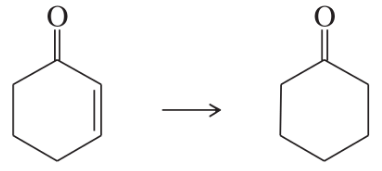
Show how you would accomplish the following transformations. You may use any additional reagents you need.
(d)

Verified step by step guidance
1
Step 1: Analyze the transformation. The starting material is a cyclohexenone (a cyclic ketone with an α,β-unsaturated double bond), and the product is cyclohexanone (a saturated cyclic ketone). This indicates that the double bond in the α,β-position needs to be reduced.
Step 2: Select an appropriate reagent for the reduction of the α,β-unsaturated double bond. A common choice is catalytic hydrogenation using H₂ gas and a metal catalyst such as palladium on carbon (Pd/C). This method selectively reduces the double bond without affecting the ketone group.
Step 3: Alternatively, if selective reduction of the double bond is required without using hydrogen gas, you can use a chemical reagent like sodium borohydride (NaBH₄) in the presence of a protic solvent, or lithium aluminum hydride (LiAlH₄) under controlled conditions.
Step 4: Perform the reaction under the chosen conditions. For catalytic hydrogenation, the reaction is typically carried out under atmospheric or slightly elevated pressure of H₂ gas in the presence of the catalyst. For chemical reduction, ensure the solvent and temperature are appropriate to avoid over-reduction.
Step 5: Confirm the product formation. Use spectroscopic techniques such as IR or NMR to verify the disappearance of the double bond and the retention of the ketone group in the product.

Verified video answer for a similar problem:

This video solution was recommended by our tutors as helpful for the problem above.
Video duration:
3m
Was this helpful?

Key Concepts

Here are the essential concepts you must grasp in order to answer the question correctly.

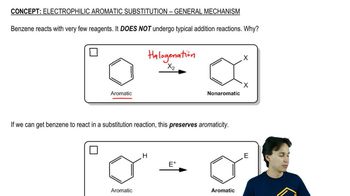
Electrophilic Aromatic Substitution

Electrophilic aromatic substitution (EAS) is a fundamental reaction in organic chemistry where an electrophile replaces a hydrogen atom on an aromatic ring. This process is crucial for modifying aromatic compounds, allowing for the introduction of various functional groups. Understanding the mechanism of EAS, including the formation of the sigma complex and the role of catalysts, is essential for predicting the outcomes of transformations involving aromatic systems.
Recommended video:

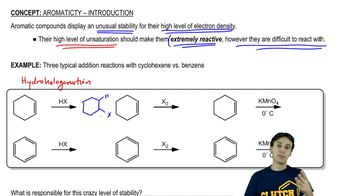
Reactivity of Aromatic Compounds

Aromatic compounds, characterized by their stable ring structure and delocalized pi electrons, exhibit unique reactivity patterns compared to aliphatic compounds. The presence of substituents on the aromatic ring can influence the reactivity and orientation of subsequent reactions, such as EAS. Recognizing how electron-donating or electron-withdrawing groups affect the stability of intermediates is vital for understanding the transformations depicted in the question.
Recommended video:
Guided course
08:19
Intro to Aromaticity

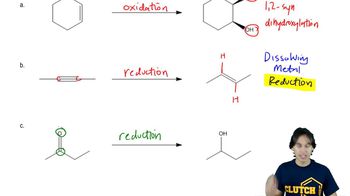
Oxidation and Reduction Reactions

Oxidation and reduction reactions are key processes in organic chemistry that involve the transfer of electrons between species. In the context of the transformation shown, understanding how to oxidize or reduce functional groups, such as converting alcohols to carbonyls or vice versa, is essential. Familiarity with common reagents and conditions for these reactions enables chemists to manipulate molecular structures effectively.
Recommended video:
Guided course
00:54
Distinguishing between Oxidation and Reduction