Ch.10 - Structure and Synthesis of Alcohols
Wade - Organic Chemistry 9th Edition
Wade9th EditionOrganic ChemistryISBN: 9780135213728Not the one you use?Change textbook
Chapter 10, Problem 17c

Show how you would add Grignard reagent to acid chloride or ester to synthesize the following alcohols.
c. dicyclohexylphenylmethanol

Verified step by step guidance
1
Step 1: Understand the reaction mechanism. Grignard reagents (R-MgX) are highly nucleophilic and react with acid chlorides or esters to form alcohols. In this case, the target alcohol is dicyclohexylphenylmethanol, which requires two equivalents of the Grignard reagent to add to the carbonyl group.
Step 2: Identify the starting material. To synthesize dicyclohexylphenylmethanol, you need an acid chloride or ester with a phenyl group attached to the carbonyl carbon. For example, phenylacetyl chloride or phenyl acetate can be used as the starting material.
Step 3: Select the Grignard reagent. The Grignard reagent should contain the cyclohexyl group (C₆H₁₁). For this synthesis, cyclohexylmagnesium bromide (C₆H₁₁-MgBr) is an appropriate choice.
Step 4: Perform the reaction. Add two equivalents of cyclohexylmagnesium bromide to the acid chloride or ester under anhydrous conditions. The first equivalent reacts with the carbonyl group to form a ketone intermediate, and the second equivalent reacts with the ketone to produce the tertiary alcohol.
Step 5: Workup and purification. After the reaction is complete, perform an acidic workup (e.g., using dilute HCl) to protonate the alkoxide intermediate and isolate the alcohol. Purify the product using techniques such as recrystallization or chromatography to obtain dicyclohexylphenylmethanol.

Verified video answer for a similar problem:

This video solution was recommended by our tutors as helpful for the problem above.
Video duration:
5m
Was this helpful?

Key Concepts

Here are the essential concepts you must grasp in order to answer the question correctly.

Grignard Reagents

Grignard reagents are organomagnesium compounds that are highly reactive and used in organic synthesis. They are formed by reacting alkyl or aryl halides with magnesium metal in dry ether. Grignard reagents act as nucleophiles, attacking electrophilic centers such as carbonyl groups in aldehydes, ketones, esters, and acid chlorides, leading to the formation of alcohols after hydrolysis.
Recommended video:
Guided course
02:12
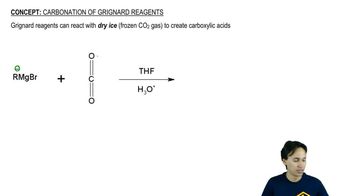
Carbonation of Grignard Reagents

Acid Chlorides and Esters

Acid chlorides and esters are important functional groups in organic chemistry. Acid chlorides are derived from carboxylic acids by replacing the hydroxyl group with a chlorine atom, making them highly reactive. Esters, on the other hand, are formed from the reaction of carboxylic acids with alcohols. Both can react with Grignard reagents to form tertiary alcohols, with acid chlorides being more reactive than esters.
Recommended video:
Guided course
03:13
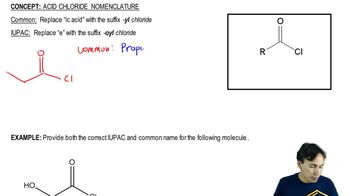
Acid Chloride Nomenclature

Synthesis of Alcohols

The synthesis of alcohols from Grignard reagents involves nucleophilic addition to carbonyl compounds. When a Grignard reagent reacts with an acid chloride or ester, it forms a tetrahedral intermediate, which upon hydrolysis yields the corresponding alcohol. This method is particularly useful for constructing complex alcohols, such as dicyclohexylphenylmethanol, by carefully selecting the appropriate Grignard reagent and carbonyl compound.
Recommended video:
Guided course
02:26
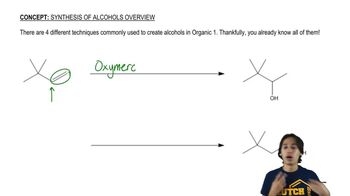
Forming alcohols through Oxymercuration-Reduction.