Ch.10 - Structure and Synthesis of Alcohols
Wade - Organic Chemistry 9th Edition
Wade9th EditionOrganic ChemistryISBN: 9780135213728Not the one you use?Change textbook
Chapter 10, Problem 15c

Show how you would synthesize following tertiary alcohol by adding an appropriate Grignard reagent to a ketone.
c. 1-ethylcyclopentanol

Verified step by step guidance
1
Identify the target molecule: The target molecule is 1-ethylcyclopentanol, which is a tertiary alcohol. Tertiary alcohols can be synthesized by reacting a ketone with a Grignard reagent.
Determine the structure of the ketone: To form 1-ethylcyclopentanol, the ketone must have a cyclopentane ring with a carbonyl group (C=O) at the appropriate position. The ketone should be 1-ethylcyclopentanone, where the ethyl group is already attached to the cyclopentane ring.
Choose the Grignard reagent: To add the necessary group to the ketone and form the tertiary alcohol, the Grignard reagent must provide a methyl group (CH₃). The appropriate Grignard reagent is methylmagnesium bromide (CH₃MgBr).
Write the reaction mechanism: The Grignard reagent (CH₃MgBr) will attack the carbonyl carbon of 1-ethylcyclopentanone. This nucleophilic addition forms a tetrahedral intermediate, where the oxygen atom becomes negatively charged.
Complete the reaction: The intermediate is then protonated by adding water (H₂O) or a dilute acid, converting the negatively charged oxygen into a hydroxyl group (-OH). This results in the formation of 1-ethylcyclopentanol, the desired tertiary alcohol.

Verified video answer for a similar problem:

This video solution was recommended by our tutors as helpful for the problem above.
Video duration:
3m
Was this helpful?

Key Concepts

Here are the essential concepts you must grasp in order to answer the question correctly.

Grignard Reagents

Grignard reagents are organomagnesium compounds that are highly reactive and used in organic synthesis. They are formed by reacting alkyl or aryl halides with magnesium metal in dry ether. Grignard reagents act as nucleophiles, attacking electrophilic carbon centers, such as those in carbonyl compounds, to form new carbon-carbon bonds.
Recommended video:
Guided course
02:12
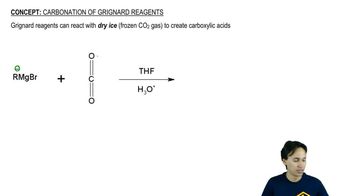
Carbonation of Grignard Reagents

Ketones

Ketones are organic compounds characterized by a carbonyl group (C=O) bonded to two carbon atoms. They are important intermediates in organic synthesis and can react with Grignard reagents to form tertiary alcohols. The reaction involves the nucleophilic attack of the Grignard reagent on the carbonyl carbon, followed by protonation to yield the alcohol.
Recommended video:
Guided course
02:27
Name the ketone

Tertiary Alcohols

Tertiary alcohols are alcohols where the hydroxyl (-OH) group is attached to a carbon atom that is connected to three other carbon atoms. They are typically formed through the reaction of Grignard reagents with ketones. The structure of tertiary alcohols influences their reactivity and stability, making them important in various chemical reactions and applications.
Recommended video:
2:07
Tertiary Protein Structure Concept 1