Ch.10 - Structure and Synthesis of Alcohols
Wade - Organic Chemistry 9th Edition
Wade9th EditionOrganic ChemistryISBN: 9780135213728Not the one you use?Change textbook
Chapter 10, Problem 44b

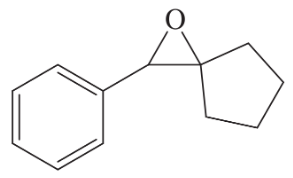
Show how you would synthesize the following compounds from any starting materials containing no more than six carbon atoms.
(b)

Verified step by step guidance
1
Step 1: Analyze the target molecule. The compound is a ketone with a cyclopentyl group and a phenyl group attached to the carbonyl carbon. This suggests that the synthesis will involve forming a ketone and attaching the two groups to the carbonyl carbon.
Step 2: Choose starting materials with no more than six carbons. For the phenyl group, benzene or a derivative like bromobenzene can be used. For the cyclopentyl group, cyclopentane or cyclopentyl bromide can be used.
Step 3: Use Friedel-Crafts acylation to introduce the phenyl group. React benzene with an acyl chloride (e.g., acetyl chloride) in the presence of AlCl₃ to form acetophenone. This introduces the phenyl group attached to a carbonyl group.
Step 4: Prepare the cyclopentyl group. Cyclopentyl bromide can be synthesized from cyclopentane using bromination. Then, use a Grignard reaction to attach the cyclopentyl group to the carbonyl carbon of acetophenone. React cyclopentyl magnesium bromide with acetophenone to form the desired ketone.
Step 5: Purify the product. Use techniques like distillation or recrystallization to isolate and purify the final compound. Confirm the structure using spectroscopic methods such as NMR or IR.

Verified video answer for a similar problem:

This video solution was recommended by our tutors as helpful for the problem above.
Video duration:
11m
Was this helpful?

Key Concepts

Here are the essential concepts you must grasp in order to answer the question correctly.

Functional Groups

Functional groups are specific groups of atoms within molecules that are responsible for the characteristic chemical reactions of those molecules. Understanding the functional groups present in the target compounds is essential for determining the appropriate reactions and starting materials needed for synthesis.
Recommended video:
Guided course
02:36
Identifying Functional Groups

Reaction Mechanisms

Reaction mechanisms describe the step-by-step process by which reactants are converted into products. Familiarity with common mechanisms, such as nucleophilic substitution or elimination reactions, is crucial for predicting how to construct the desired compounds from simpler starting materials.
Recommended video:
Guided course
02:16
Heck Reaction Mechanism

Retrosynthetic Analysis

Retrosynthetic analysis is a strategy used in organic synthesis to deconstruct a target molecule into simpler precursor structures. This approach helps chemists identify viable starting materials and the necessary reactions to achieve the desired compound, making it a fundamental tool in synthetic organic chemistry.
Recommended video:
Guided course
01:22
Retrosynthesis