Ch.10 - Structure and Synthesis of Alcohols
Wade - Organic Chemistry 9th Edition
Wade9th EditionOrganic ChemistryISBN: 9780135213728Not the one you use?Change textbook
Chapter 10, Problem 39a

Show how you would use Grignard syntheses to prepare the following alcohol from the indicated starting material and any other necessary reagents.
(a) octan-3-ol from hexanal, CH3(CH2)4CHO

Verified step by step guidance
1
Step 1: Understand the problem. You are tasked with synthesizing octan-3-ol from hexanal using a Grignard reaction. Grignard reagents are organomagnesium compounds (R-MgX) that act as nucleophiles and can add to carbonyl compounds to form alcohols after hydrolysis.
Step 2: Identify the target alcohol and the starting material. The target alcohol is octan-3-ol, which has a hydroxyl group (-OH) on the third carbon of an eight-carbon chain. The starting material is hexanal, CH3(CH2)4CHO, which is a six-carbon aldehyde.
Step 3: Determine the Grignard reagent needed. To extend the carbon chain of hexanal to form octan-3-ol, you need to add a two-carbon fragment. This can be achieved using ethylmagnesium bromide (CH3CH2MgBr) as the Grignard reagent.
Step 4: Perform the Grignard reaction. React hexanal with ethylmagnesium bromide. The nucleophilic ethyl group (CH3CH2-) from the Grignard reagent will attack the electrophilic carbonyl carbon of hexanal, forming a magnesium alkoxide intermediate.
Step 5: Hydrolyze the intermediate. Treat the magnesium alkoxide intermediate with water or a dilute acid (e.g., H3O+) to protonate the oxygen and form the final alcohol, octan-3-ol.

Verified video answer for a similar problem:

This video solution was recommended by our tutors as helpful for the problem above.
Video duration:
3m
Was this helpful?

Key Concepts

Here are the essential concepts you must grasp in order to answer the question correctly.

Grignard Reagents

Grignard reagents are organomagnesium compounds, typically represented as R-MgX, where R is an organic group and X is a halogen. They are highly reactive and can act as nucleophiles, attacking electrophilic carbon atoms in carbonyl compounds. This property makes them essential in organic synthesis, particularly for forming carbon-carbon bonds and creating alcohols from aldehydes and ketones.
Recommended video:
Guided course
02:12
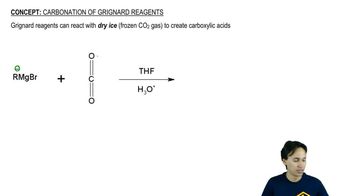
Carbonation of Grignard Reagents

Aldehyde Reactivity

Aldehydes, such as hexanal, are characterized by the presence of a carbonyl group (C=O) at the terminal position of the carbon chain. They are more reactive than ketones due to the accessibility of the carbonyl carbon for nucleophilic attack. In the context of Grignard synthesis, the carbonyl carbon of the aldehyde can be attacked by a Grignard reagent, leading to the formation of a corresponding alcohol after hydrolysis.
Recommended video:
Guided course
01:34
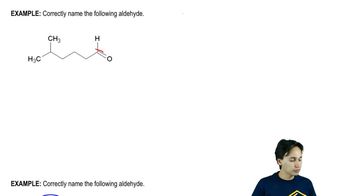
Name the aldehyde

Hydrolysis of Grignard Products

After a Grignard reagent reacts with an aldehyde, the resulting alkoxide intermediate must be converted into the final alcohol product. This is achieved through hydrolysis, where the reaction mixture is treated with water or an acid. The hydrolysis step is crucial as it protonates the alkoxide, yielding the desired alcohol, such as octan-3-ol in this case.
Recommended video:
1:00
Hydrolysis of Thioesters Concept 2