

(b) Under the same conditions, an optically active sample of trans-2-bromocyclopentanol reacts with concentrated aqueous HBr to give an optically inactive product, (racemic) trans-1,2-dibromocyclopentane. Propose a mechanism to show how this reaction goes with apparently complete retention of configuration, yet with racemization. (Hint: Draw out the mechanism of the reaction of cyclopentene with Br2 in water to give the starting material, trans-2- bromocyclopentanol. Consider how parts of this mechanism might be involved in the reaction with HBr.)
Alcohols combine with ketones and aldehydes to form interesting derivatives, which we will discuss in Chapter 18. The following reactions show the hydrolysis of two such derivatives. Propose mechanisms for these reactions.
(b) 
Verified step by step guidance
Verified video answer for a similar problem:
Key Concepts
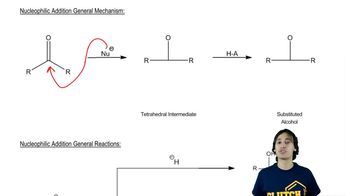
Nucleophilic Addition
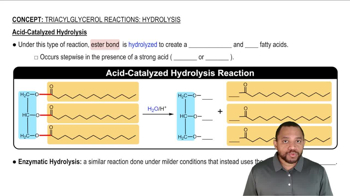
Hydrolysis Reactions
Reaction Mechanisms
(a) The reaction of butan-2-ol with concentrated aqueous HBr goes with partial racemization, giving more inversion than retention of configuration. Propose a mechanism that accounts for racemization with excess inversion.
Under normal circumstances, tertiary alcohols are not oxidized. However, when the tertiary alcohol is allylic, it can undergo a migration of the double bond (called an allylic shift) and subsequent oxidation of the alcohol. A particularly effective reagent for this reaction is Bobbitt's reagent, similar to TEMPO used in many oxidations. (M. Shibuya et al., J. Org. Chem., 2008, 73, 4750.)
Show the expected product when each of these 3° allylic alcohols is oxidized by Bobbitt's reagent.
(a)
(b)
Under normal circumstances, tertiary alcohols are not oxidized. However, when the tertiary alcohol is allylic, it can undergo a migration of the double bond (called an allylic shift) and subsequent oxidation of the alcohol. A particularly effective reagent for this reaction is Bobbitt's reagent, similar to TEMPO used in many oxidations. (M. Shibuya et al., J. Org. Chem., 2008, 73, 4750.)
Show the expected product when each of these 3° allylic alcohols is oxidized by Bobbitt’s reagent
(c)
(d)
Alcohols combine with ketones and aldehydes to form interesting derivatives, which we will discuss in Chapter 18. The following reactions show the hydrolysis of two such derivatives. Propose mechanisms for these reactions.
(a)
