
Ch.11 - Reactions of Alcohols
Wade - Organic Chemistry 9th Edition
Wade9th EditionOrganic ChemistryISBN: 9780135213728Not the one you use?Change textbook
Chapter 11, Problem 4a,b

Give the structure of the principal product(s) when each of the following alcohols reacts with (1) Na2Cr2O7/H2SO4, (2) PCC, (3) DMP, and (4) 1 equiv NaOCl-TEMPO.
a. octan-1-ol
b. octan-3-ol

Verified step by step guidance
1
Step 1: Understand the nature of the alcohols provided. Octan-1-ol is a primary alcohol, while octan-3-ol is a secondary alcohol. The type of alcohol determines the oxidation products when treated with different oxidizing agents.
Step 2: Analyze the reaction with Na2Cr2O7/H2SO4. This is a strong oxidizing agent that oxidizes primary alcohols (like octan-1-ol) to carboxylic acids and secondary alcohols (like octan-3-ol) to ketones.
Step 3: Examine the reaction with PCC (Pyridinium Chlorochromate). PCC is a milder oxidizing agent that oxidizes primary alcohols to aldehydes without further oxidation to carboxylic acids. Secondary alcohols are oxidized to ketones.
Step 4: Consider the reaction with DMP (Dess-Martin Periodinane). DMP is another mild oxidizing agent that behaves similarly to PCC, oxidizing primary alcohols to aldehydes and secondary alcohols to ketones.
Step 5: Evaluate the reaction with 1 equiv NaOCl-TEMPO. This reagent selectively oxidizes primary alcohols to aldehydes and secondary alcohols to ketones, similar to PCC and DMP. The '1 equiv' indicates controlled oxidation without overoxidation.

Verified video answer for a similar problem:

This video solution was recommended by our tutors as helpful for the problem above.
Video duration:
12m
Was this helpful?

Key Concepts

Here are the essential concepts you must grasp in order to answer the question correctly.

Oxidation of Alcohols

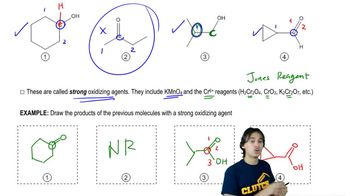
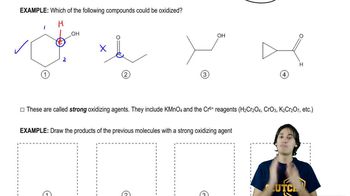
Alcohols can undergo oxidation to form carbonyl compounds, such as aldehydes and ketones, depending on the structure of the alcohol and the oxidizing agent used. Primary alcohols typically oxidize to aldehydes and then to carboxylic acids, while secondary alcohols oxidize to ketones. Understanding the oxidation state changes and the types of products formed is crucial for predicting the outcomes of reactions with different oxidizing agents.
Recommended video:
Guided course
05:53
Strong oxidizing agents

Oxidizing Agents

Different oxidizing agents have varying strengths and selectivities for alcohol oxidation. For example, Na2Cr2O7 in acidic conditions is a strong oxidizer that can fully oxidize primary alcohols to carboxylic acids, while PCC (Pyridinium chlorochromate) is milder and typically oxidizes primary alcohols to aldehydes and secondary alcohols to ketones. DMP (Dess-Martin periodinane) is another mild oxidant that selectively oxidizes alcohols to carbonyls without over-oxidation.
Recommended video:
Guided course
03:40
Strong oxidizing agents

Mechanism of Alcohol Oxidation

The mechanism of alcohol oxidation generally involves the formation of a chromate ester intermediate, followed by the loss of water and the formation of a carbonyl compound. Understanding this mechanism helps in predicting the reaction pathway and the stability of intermediates. Additionally, the role of the solvent and reaction conditions can influence the mechanism and the final products formed during the oxidation process.
Recommended video:
Guided course
05:53
Strong oxidizing agents
Related Practice
Textbook Question

We have covered several oxidants that use a multi-valent atom (Cr, Cl, S, or I) as their active species, going from a higher oxidation state before the oxidation to a lower oxidation state after oxidizing the alcohol. Draw the Lewis structures of the following atoms, before and after the oxidation of an alcohol to a ketone or aldehyde. How many bonds to oxygen does each atom have before and after the oxidation?

a. the Cr in chromic acid

b. the Cl in sodium hypochlorite

c. the S in the Swern oxidation

1057
views
Textbook Question

Give the structure of the principal product(s) when each of the following alcohols reacts with (1) Na2Cr2O7/H2SO4, (2) PCC

d. 1-methylcyclohexan-1,4-diol

648
views
Textbook Question

Predict the products of the reactions of the following compounds with:

1. chromic acid or excess sodium hypochlorite with acetic acid.

2. PCC or NaOCl (1 equivalent) with TEMPO.

f. 1-phenylpropan-1-ol

681
views
Textbook Question

Give the structure of the principal product(s) when each of the following alcohols reacts with (3) DMP, and (4) 1 equiv NaOCl-TEMPO.

c. 4-hydroxydecanal

710
views
Textbook Question

Give the structure of the principal product(s) when each of the following alcohols reacts with (1) Na2Cr2O7/H2SO4, (2) PCC

c. 4-hydroxydecanal

815
views
Textbook Question

Predict the products of the reactions of the following compounds with:

1. chromic acid or excess sodium hypochlorite with acetic acid.

2. PCC or NaOCl (1 equivalent) with TEMPO.

g. hexan-1-ol

h. acetaldehyde, CH3CHO

868
views