Ch.11 - Reactions of Alcohols
Wade - Organic Chemistry 9th Edition
Wade9th EditionOrganic ChemistryISBN: 9780135213728Not the one you use?Change textbook
Chapter 11, Problem 53

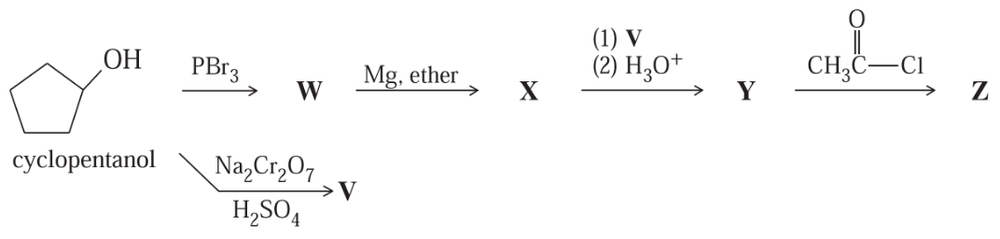
Give the structures of the intermediates and products V through Z.

Verified step by step guidance
1
Step 1: Analyze the first reaction in the sequence. Cyclopentanol reacts with PBr₃, which is a reagent used to convert alcohols into alkyl bromides. The hydroxyl group (-OH) of cyclopentanol is replaced by a bromine atom, forming cyclopentyl bromide (W).
Step 2: In the second reaction, cyclopentyl bromide (W) reacts with magnesium in ether. This reaction forms a Grignard reagent, cyclopentyl magnesium bromide (X). Grignard reagents are highly reactive organometallic compounds used in nucleophilic addition reactions.
Step 3: Cyclopentanol undergoes oxidation with Na₂Cr₂O₇ in H₂SO₄ to form cyclopentanone (V). This is a typical oxidation reaction where a secondary alcohol is converted into a ketone.
Step 4: The Grignard reagent (X) reacts with cyclopentanone (V) in the presence of H₃O⁺. This reaction forms a tertiary alcohol (Y) through nucleophilic addition of the Grignard reagent to the ketone group of cyclopentanone.
Step 5: The tertiary alcohol (Y) reacts with acetyl chloride (CH₃COCl). This reaction involves acylation, where the hydroxyl group of the alcohol is replaced by an acetyl group, forming an ester (Z).

Verified video answer for a similar problem:

This video solution was recommended by our tutors as helpful for the problem above.
Video duration:
5m
Was this helpful?

Key Concepts

Here are the essential concepts you must grasp in order to answer the question correctly.

Reactions of Alcohols

Alcohols can undergo various reactions, including conversion to alkyl halides. In this case, cyclopentanol is treated with phosphorus tribromide (PBr3), which facilitates the substitution of the hydroxyl group (-OH) with a bromine atom, forming an alkyl bromide. This step is crucial for generating the intermediate W.
Recommended video:
Guided course
01:44
Forming alcohols through SN2 reactions.

Grignard Reagents

Grignard reagents are organomagnesium compounds that react with electrophiles to form new carbon-carbon bonds. In the reaction sequence, the alkyl bromide formed from cyclopentanol reacts with magnesium in ether to produce a Grignard reagent (X). This reagent is highly reactive and can further react with carbonyl compounds in subsequent steps.
Recommended video:
Guided course
02:12
Carbonation of Grignard Reagents

Oxidation and Functional Group Transformations

Oxidation reactions involve the increase of oxidation state, often resulting in the formation of carbonyl compounds. In this sequence, the Grignard reagent (X) reacts with a carbonyl compound to form an alcohol (Y), which can then be oxidized using sodium dichromate (Na2Cr2O7) in sulfuric acid (H2SO4) to yield a ketone (Z). Understanding these transformations is essential for predicting the structures of intermediates and products.
Recommended video:
Guided course
02:36
Identifying Functional Groups
Related Practice
Textbook Question

Propose mechanisms for the following reactions. In most cases, more products are formed than are shown here. You only need to explain the formation of the products shown, however.

(b)

679
views

Textbook Question

Propose mechanisms for the following reactions. In most cases, more products are formed than are shown here. You only need to explain the formation of the products shown, however.

(a)

934
views
Textbook Question

Under acid catalysis, tetrahydrofurfuryl alcohol reacts to give surprisingly good yields of dihydropyran. Propose a mechanism to explain this useful synthesis.

680
views
Textbook Question

Predict the major products (including stereochemistry) when cis-3-methylcyclohexanol reacts with the following reagents.

(d) concentrated HBr

(e) TsCl/pyridine, then NaBr

1088
views
Textbook Question

Compound A is an optically active alcohol. Treatment with chromic acid converts A into a ketone, B. In a separate reaction, A is treated with PBr3, converting A into compound C. Compound C is purified, and then it is allowed to react with magnesium in ether to give a Grignard reagent, D. Compound B is added to the resulting solution of the Grignard reagent. After hydrolysis of the initial product (E), this solution is found to contain 3,4-dimethylhexan-3-ol. Propose structures for compounds A, B, C, D, and E.

1798
views
Textbook Question

The compound shown below has three different types of OH groups, all with different acidities. Show the structure produced after this compound is treated with different amounts of NaH followed by a methylating reagent. Add a brief explanation.

(a) 1 equivalent of NaH, followed by 1 equivalent of CH3I and heat

(b) 2 equivalents of NaH, followed by 2 equivalents of CH3I and heat

(c) 3 equivalents of NaH, followed by 3 equivalents of CH3I and heat

1093
views