
Textbook Question
To practice working through the early parts of a multistep synthesis, devise syntheses of
(b) 3-ethylpentan-2-one from compounds containing no more than three carbon atoms.
1124
views

 Verified step by step guidance
 02:27
02:27
 03:50
03:50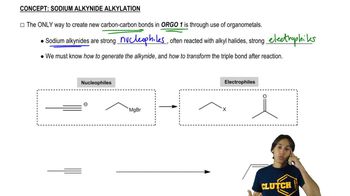 03:19
03:19To practice working through the early parts of a multistep synthesis, devise syntheses of
(b) 3-ethylpentan-2-one from compounds containing no more than three carbon atoms.
To practice working through the early parts of a multistep synthesis, devise syntheses of
(a) pentan-3-one from alcohols containing no more than three carbon atoms.
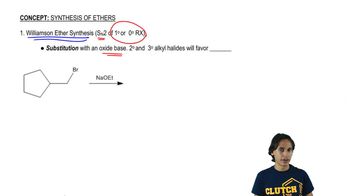
A student wanted to use the Williamson ether synthesis to make (R)-2-ethoxybutane. He remembered that the Williamson synthesis involves an SN2 displacement, which takes place with inversion of configuration. He ordered a bottle of (S)-butan-2-ol for his chiral starting material. He also remembered that the SN2 goes best on primary halides and tosylates, so he made ethyl tosylate and sodium (S)-but-2-oxide. After warming these reagents together, he obtained an excellent yield of 2-ethoxybutane.
a. What enantiomer of 2-ethoxybutane did he obtain? Explain how this enantiomer results from the SN2 reaction of ethyl tosylate with sodium (S)-but-2-oxide.
b. What would have been the best synthesis of (R)-2-ethoxybutane?
c. How can this student convert the rest of his bottle of (S)-butan-2-ol to (R)-2-ethoxybutane?
A good Williamson synthesis of ethyl methyl ether would be
What is wrong with the following proposed synthesis of ethyl methyl ether? First, ethanol is treated with acid to protonate the hydroxy group (making it a good leaving group), and then sodium methoxide is added to displace water.
(a) Show how ethanol and cyclohexanol may be used to synthesize cyclohexyl ethyl ether (tosylation followed by the Williamson ether synthesis).
(b) Why can't we synthesize this product simply by mixing the two alcohols, adding some sulfuric acid, and heating?
Develop syntheses for the following compounds. As starting materials, you may use cyclopentanol, alcohols containing no more than four carbon atoms, and any common reagents and solvents.
(a) trans-cyclopentane-1,2-diol