Ch.11 - Reactions of Alcohols
Wade - Organic Chemistry 9th Edition
Wade9th EditionOrganic ChemistryISBN: 9780135213728Not the one you use?Change textbook
Chapter 11, Problem 2e

Predict the products of the reactions of the following compounds with:
1. chromic acid or excess sodium hypochlorite with acetic acid.
2. PCC or NaOCl (1 equivalent) with TEMPO.
e. cyclohexane

Verified step by step guidance
1
Step 1: Understand the reagents and their roles. Chromic acid (H2CrO4) and sodium hypochlorite (NaOCl) with acetic acid are strong oxidizing agents. They can oxidize primary alcohols to carboxylic acids and secondary alcohols to ketones. PCC (Pyridinium chlorochromate) and NaOCl with TEMPO are milder oxidizing agents. PCC oxidizes primary alcohols to aldehydes and secondary alcohols to ketones, while NaOCl with TEMPO selectively oxidizes primary alcohols to aldehydes.
Step 2: Analyze the structure of cyclohexane. Cyclohexane is a saturated hydrocarbon (alkane) with no functional groups like alcohols or double bonds. Since oxidation reactions typically target functional groups such as alcohols or alkenes, cyclohexane is unlikely to react with these oxidizing agents under normal conditions.
Step 3: Predict the reaction with chromic acid or excess sodium hypochlorite with acetic acid. Since cyclohexane lacks functional groups that can be oxidized, it will remain unreacted in the presence of these strong oxidizing agents.
Step 4: Predict the reaction with PCC or NaOCl (1 equivalent) with TEMPO. Similarly, as cyclohexane does not contain any alcohol groups, it will not undergo oxidation with these milder oxidizing agents.
Step 5: Conclude the analysis. Cyclohexane is inert to the given oxidizing agents because it lacks functional groups that can be oxidized. Therefore, no reaction occurs, and the product remains cyclohexane.

Verified video answer for a similar problem:

This video solution was recommended by our tutors as helpful for the problem above.
Video duration:
1m
Was this helpful?

Key Concepts

Here are the essential concepts you must grasp in order to answer the question correctly.

Oxidation Reactions

Oxidation reactions involve the loss of electrons or an increase in oxidation state of a molecule. In organic chemistry, this often pertains to the conversion of alcohols to carbonyl compounds (aldehydes or ketones) or further to carboxylic acids. Understanding the specific oxidizing agents, such as chromic acid or sodium hypochlorite, is crucial for predicting the products of these reactions.
Recommended video:
Guided course
03:20
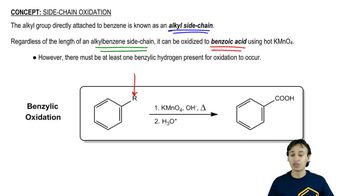
Benzylic Oxidation

Oxidizing Agents

Oxidizing agents are substances that facilitate the oxidation of other compounds by accepting electrons. Chromic acid and sodium hypochlorite are common oxidizing agents used in organic synthesis. Their strength and reactivity can vary, influencing the extent of oxidation and the resulting products, such as whether a primary alcohol is oxidized to an aldehyde or a carboxylic acid.
Recommended video:
Guided course
03:40
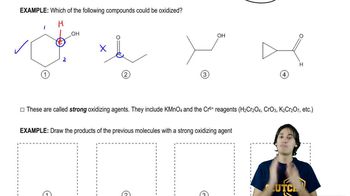
Strong oxidizing agents

Selective Oxidation

Selective oxidation refers to the ability to oxidize specific functional groups in a molecule without affecting others. Reagents like PCC (Pyridinium chlorochromate) and TEMPO (2,2,6,6-tetramethylpiperidinyl-1-oxyl) are designed for this purpose, allowing for controlled oxidation of alcohols to aldehydes or ketones. Understanding the selectivity of these reagents is essential for predicting the outcomes of reactions involving complex organic molecules.
Recommended video:
Guided course
03:20
Benzylic Oxidation
Related Practice
Textbook Question

Predict the products of the reactions of the following compounds with:

1. chromic acid or excess sodium hypochlorite with acetic acid.

2. PCC or NaOCl (1 equivalent) with TEMPO.

d. cyclohexanone

982
views

Textbook Question

We have covered several oxidants that use a multi-valent atom (Cr, Cl, S, or I) as their active species, going from a higher oxidation state before the oxidation to a lower oxidation state after oxidizing the alcohol. Draw the Lewis structures of the following atoms, before and after the oxidation of an alcohol to a ketone or aldehyde. How many bonds to oxygen does each atom have before and after the oxidation?

a. the Cr in chromic acid

b. the Cl in sodium hypochlorite

c. the S in the Swern oxidation

1057
views
Textbook Question

Classify each reaction as an oxidation, a reduction, or neither.

(j)

(k)

(l)

949
views
Textbook Question

Predict the products of the reactions of the following compounds with:

1. chromic acid or excess sodium hypochlorite with acetic acid.

2. PCC or NaOCl (1 equivalent) with TEMPO.

f. 1-phenylpropan-1-ol

681
views
Textbook Question

Predict the products of the reactions of the following compounds with:

1. chromic acid or excess sodium hypochlorite with acetic acid.

2. PCC or NaOCl (1 equivalent) with TEMPO.

a. cyclohexanol

b. 1-methylcyclohexanol

c. cyclopentylmethanol

1908
views
Textbook Question

Predict the products of the reactions of the following compounds with:

1. chromic acid or excess sodium hypochlorite with acetic acid.

2. PCC or NaOCl (1 equivalent) with TEMPO.

g. hexan-1-ol

h. acetaldehyde, CH3CHO

868
views