Ch.11 - Reactions of Alcohols
Wade - Organic Chemistry 9th Edition
Wade9th EditionOrganic ChemistryISBN: 9780135213728Not the one you use?Change textbook
Chapter 11, Problem 56g

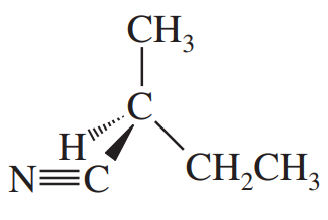
Show how you would synthesize the following compounds. As starting materials, you may use any alcohols containing four or fewer carbon atoms, cyclohexanol, and any necessary solvents and inorganic reagents.
(g) Chemical structure diagram showing a carbon atom bonded to a nitrogen atom and three alkyl groups.

Verified step by step guidance
1
Step 1: Analyze the target molecule. The compound contains a nitrile group (-C≡N) attached to a carbon atom that is also bonded to a hydrogen atom, a methyl group (-CH3), and an ethyl group (-CH2CH3). This suggests that the synthesis involves forming a nitrile group and constructing the correct carbon framework.
Step 2: Start with a suitable alcohol as the starting material. Since alcohols with four or fewer carbon atoms are allowed, choose 2-butanol (CH3CH(OH)CH2CH3) as the starting material. This alcohol has the correct carbon framework to form the desired product.
Step 3: Convert the alcohol to a halide. Use a reagent like thionyl chloride (SOCl2) or phosphorus tribromide (PBr3) to convert 2-butanol into 2-bromobutane (CH3CH(Br)CH2CH3). This step introduces a good leaving group for subsequent reactions.
Step 4: Perform a nucleophilic substitution reaction to introduce the nitrile group. React 2-bromobutane with sodium cyanide (NaCN) in an appropriate solvent like dimethyl sulfoxide (DMSO). This reaction replaces the bromine atom with a nitrile group, forming 2-butanenitrile (CH3CH(C≡N)CH2CH3).
Step 5: Ensure stereochemistry. If the target molecule requires a specific stereochemistry (e.g., the hydrogen and nitrile group are on opposite sides of the carbon atom), use appropriate conditions or reagents to control the stereochemistry during the substitution step. Verify the stereochemistry of the product using spectroscopic methods like NMR.

Verified video answer for a similar problem:

This video solution was recommended by our tutors as helpful for the problem above.
Video duration:
2m
Was this helpful?

Key Concepts

Here are the essential concepts you must grasp in order to answer the question correctly.

Alcohols as Reactants

Alcohols are organic compounds containing one or more hydroxyl (-OH) groups. In synthesis, they can act as nucleophiles or electrophiles depending on the reaction conditions. Understanding the reactivity of different alcohols, especially those with four or fewer carbon atoms, is crucial for designing synthetic pathways to target compounds.
Recommended video:
Guided course
01:01
How to name alcohols

Functional Group Transformations

Functional group transformations involve converting one functional group into another through various chemical reactions. This concept is essential in organic synthesis, as it allows chemists to modify the structure of starting materials to create desired products. Familiarity with common transformations, such as oxidation, reduction, and substitution, is vital for effective synthesis.
Recommended video:
Guided course
02:36
Identifying Functional Groups

Reagents and Solvents in Organic Synthesis

Reagents and solvents play a critical role in organic synthesis by influencing reaction mechanisms and outcomes. In this context, inorganic reagents may be used to facilitate transformations, while solvents can affect solubility and reaction rates. Understanding the properties and roles of different reagents and solvents is essential for optimizing synthetic routes.
Recommended video:
Guided course
01:16
Identification of polarity in solvents