
Ch.11 - Reactions of Alcohols
Wade - Organic Chemistry 9th Edition
Wade9th EditionOrganic ChemistryISBN: 9780135213728Not the one you use?Change textbook
Chapter 11, Problem 13

The reaction of tert-butyl alcohol with concentrated HCl goes by the SN1 mechanism. Write a mechanism for this reaction.

Verified step by step guidance
1
Identify the substrate: tert-butyl alcohol (C(CH₃)₃OH) is a tertiary alcohol, which makes it prone to undergoing the SN1 mechanism due to the stability of the tertiary carbocation intermediate.
Protonation of the alcohol group: The concentrated HCl provides a proton (H⁺), which protonates the hydroxyl group (-OH) of tert-butyl alcohol, converting it into a better leaving group (H₂O). The reaction can be represented as: C(CH₃)₃OH + H⁺ → C(CH₃)₃OH₂⁺.
Formation of the carbocation: The protonated alcohol group (H₂O) leaves, forming a tertiary carbocation. This is the rate-determining step of the SN1 mechanism. The reaction can be represented as: C(CH₃)₃OH₂⁺ → C(CH₃)₃⁺ + H₂O.
Nucleophilic attack: The chloride ion (Cl⁻) from HCl acts as a nucleophile and attacks the carbocation, forming the final product, tert-butyl chloride (C(CH₃)₃Cl). The reaction can be represented as: C(CH₃)₃⁺ + Cl⁻ → C(CH₃)₃Cl.
Summarize the mechanism: The overall reaction involves protonation of the alcohol, loss of water to form a carbocation, and nucleophilic attack by chloride to yield tert-butyl chloride. This is a classic example of an SN1 reaction, characterized by a two-step mechanism with a carbocation intermediate.

Verified video answer for a similar problem:

This video solution was recommended by our tutors as helpful for the problem above.
Video duration:
3m
Was this helpful?

Key Concepts

Here are the essential concepts you must grasp in order to answer the question correctly.

SN1 Mechanism

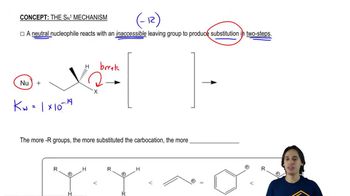
The SN1 mechanism, or unimolecular nucleophilic substitution, involves two main steps: the formation of a carbocation intermediate and the nucleophilic attack. In the first step, the leaving group departs, creating a positively charged carbocation. The second step involves a nucleophile attacking this carbocation, resulting in the substitution product. This mechanism is favored in tertiary substrates due to their ability to stabilize the carbocation.
Recommended video:
Guided course
10:49
Drawing the SN1 Mechanism

Carbocation Stability

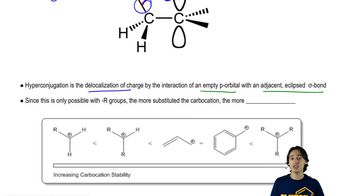
Carbocation stability is crucial in determining the pathway of a reaction. Tertiary carbocations are more stable than secondary or primary ones due to hyperconjugation and inductive effects from surrounding alkyl groups. This stability allows for the formation of the carbocation in the SN1 mechanism, making it a key factor in reactions involving tertiary alcohols like tert-butyl alcohol.
Recommended video:
Guided course
05:58
Determining Carbocation Stability

Role of Concentrated HCl

Concentrated hydrochloric acid (HCl) serves as both a strong acid and a source of chloride ions in the reaction with tert-butyl alcohol. The acid protonates the alcohol, enhancing the leaving ability of the water molecule formed, which then departs to generate the carbocation. This protonation step is essential for initiating the SN1 mechanism, facilitating the overall reaction process.
Recommended video:
1:10
Coenzyme A Example 5