Ch. 12 - Infrared Spectroscopy and Mass Spectrometry
Wade - Organic Chemistry 9th Edition
Wade9th EditionOrganic ChemistryISBN: 9780135213728Not the one you use?Change textbook
Chapter 12, Problem 19a,b

A common lab experiment is the dehydration of cyclohexanol to cyclohexene.
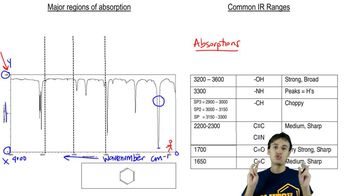
(a) Explain how you could tell from the IR spectrum whether your product was pure cyclohexene, pure cyclohexanol, or a mixture of cyclohexene and cyclohexanol. Give approximate frequencies for distinctive peaks.
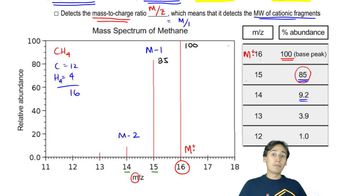
(b) Explain why mass spectrometry might not be a good way to distinguish cyclohexene from cyclohexanol.

Verified step by step guidance
1
Step 1: Understand the IR spectrum and its relevance. Infrared (IR) spectroscopy is a technique used to identify functional groups in a molecule based on the absorption of infrared light at specific frequencies. Cyclohexanol (an alcohol) and cyclohexene (an alkene) have distinct functional groups that absorb IR light at different frequencies.
Step 2: Identify the key IR peaks for cyclohexanol. Cyclohexanol contains an -OH group, which gives a broad absorption peak around 3200-3600 cm-1 due to O-H stretching. Additionally, C-H stretching vibrations for sp3 carbons appear around 2800-3000 cm-1.
Step 3: Identify the key IR peaks for cyclohexene. Cyclohexene contains a C=C double bond, which gives a sharp absorption peak around 1600-1680 cm-1. It also has C-H stretching vibrations for sp2 carbons, which appear around 3000-3100 cm-1. Unlike cyclohexanol, it lacks the broad O-H peak.
Step 4: Compare the IR spectrum of the product. If the IR spectrum shows a broad O-H peak (3200-3600 cm-1), the product contains cyclohexanol. If the spectrum shows a sharp C=C peak (1600-1680 cm-1) and sp2 C-H stretching (3000-3100 cm-1), the product contains cyclohexene. If both sets of peaks are present, the product is a mixture of cyclohexanol and cyclohexene.
Step 5: Explain why mass spectrometry might not be ideal. Mass spectrometry identifies compounds based on their molecular weight and fragmentation patterns. Cyclohexanol (molecular weight = 100 g/mol) and cyclohexene (molecular weight = 82 g/mol) have different molecular weights, but their fragmentation patterns may overlap, making it difficult to distinguish between the two compounds. Additionally, mass spectrometry does not provide direct information about functional groups, unlike IR spectroscopy.

Verified video answer for a similar problem:

This video solution was recommended by our tutors as helpful for the problem above.
Video duration:
2m
Was this helpful?

Key Concepts

Here are the essential concepts you must grasp in order to answer the question correctly.

Infrared (IR) Spectroscopy

IR spectroscopy is a technique used to identify molecular structures based on the absorption of infrared light by chemical bonds. Different functional groups absorb characteristic frequencies of IR radiation, leading to distinct peaks in the spectrum. For instance, cyclohexanol exhibits a broad O-H stretch around 3200-3600 cm⁻¹, while cyclohexene shows C=C stretching around 1640-1680 cm⁻¹. Analyzing these peaks helps determine the purity and identity of the compounds.
Recommended video:
Guided course
16:04
General Features of IR Spect

Mass Spectrometry

Mass spectrometry is an analytical technique that measures the mass-to-charge ratio of ions to identify and quantify molecules. While it can provide information about molecular weight and fragmentation patterns, it may not effectively distinguish between similar compounds like cyclohexene and cyclohexanol, which have close molecular weights and similar fragmentation pathways. This can lead to overlapping signals, making it challenging to differentiate between them.
Recommended video:
Guided course
01:25
How to Read a Mass Spectrum

Purity Assessment in Organic Chemistry

Assessing the purity of organic compounds is crucial in chemistry, as impurities can affect reactivity and properties. Techniques like IR spectroscopy allow chemists to identify the presence of specific functional groups, indicating whether a sample is pure or a mixture. In the case of cyclohexene and cyclohexanol, the presence of characteristic peaks in the IR spectrum can reveal the composition of the sample, aiding in the determination of purity.
Recommended video:
Guided course
00:56
What is an organic molecule?
Related Practice
Textbook Question

Predict the masses and the structures of the most abundant fragments observed in the mass spectra of the following compounds.

(c) 4-methylpentan-2-ol

1451
views

Textbook Question

Predict the masses and the structures of the most abundant fragments observed in the mass spectra of the following compounds.

(b) 3-methylhex-2-ene

1465
views
Textbook Question

A laboratory student added 1-bromobutane to a flask containing dry ether and magnesium turnings. An exothermic reaction resulted, and the ether boiled vigorously for several minutes. Then she added acetone to the reaction mixture and the ether boiled even more vigorously. She added dilute acid to the mixture and separated the layers. She evaporated the ether layer, and distilled a liquid that boiled at 143 °C. GC–MS analysis of the distillate showed one major product with a few minor impurities. The mass spectrum of the major product is shown here.

(a) Draw out the reactions that took place and show the product that was formed.

<IMAGE>

1405
views
Textbook Question

Predict the masses and the structures of the most abundant fragments observed in the mass spectra of the following compounds. (a) 2-methylpentane

1414
views
Textbook Question

A laboratory student added 1-bromobutane to a flask containing dry ether and magnesium turnings. An exothermic reaction resulted, and the ether boiled vigorously for several minutes. Then she added acetone to the reaction mixture and the ether boiled even more vigorously. She added dilute acid to the mixture and separated the layers. She evaporated the ether layer, and distilled a liquid that boiled at 143 °C. GC–MS analysis of the distillate showed one major product with a few minor impurities. The mass spectrum of the major product is shown here.

(b) Explain why the molecular ion is or is not visible in the mass spectrum, and show what ions are likely to be responsible for the strong peaks at m/z 59 and 101.

<IMAGE>

1398
views
Textbook Question

A C-D (carbon–deuterium) bond is electronically much like a C-H bond, and it has a similar stiffness, measured by the spring constant, k. The deuterium atom has twice the mass (m) of a hydrogen atom, however.

(a) The infrared absorption frequency is approximately proportional to km\(\sqrt{\frac{k}{m}\)} , when one of the bonded atoms is much heavier than the other, and m is the lighter of the two atoms (H or D in this case). Use this relationship to calculate the IR absorption frequency of a typical C-D bond. Use 3000 cm–1 as a typical C-H absorption frequency.

(b) A chemist dissolves a sample in deuterochloroform (CDCl3) and then decides to take the IR spectrum and simply evaporates most of the CDCl3. What functional group will appear to be present in this IR spectrum as a result of the CDCl3 impurity?

2580
views