

Ch. 12 - Infrared Spectroscopy and Mass Spectrometry
Wade - Organic Chemistry 9th Edition
Wade9th EditionOrganic ChemistryISBN: 9780135213728Not the one you use?Change textbook
Chapter 12, Problem 12d,e,f

Predict the characteristic infrared absorptions of the functional groups in the following molecules.
(d) pent-1-yne
(e) diethylamine
(f) pentanoic acid

Verified step by step guidance
1
Step 1: Understand the functional groups present in each molecule. For pent-1-yne, the functional group is a terminal alkyne (-C≡C-H). For diethylamine, the functional group is a secondary amine (-NH). For pentanoic acid, the functional group is a carboxylic acid (-COOH).
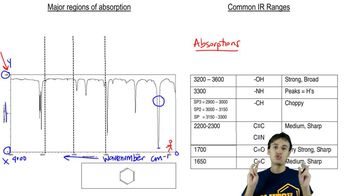
Step 2: Recall the characteristic infrared (IR) absorption ranges for each functional group. Terminal alkynes typically show a sharp C≡C stretch around 2100-2260 cm⁻¹ and a C-H stretch for the terminal alkyne around 3300 cm⁻¹. Secondary amines exhibit N-H stretching vibrations around 3300-3500 cm⁻¹ (broad, often with two peaks). Carboxylic acids show a broad O-H stretch around 2500-3300 cm⁻¹ and a strong C=O stretch around 1700-1725 cm⁻¹.
Step 3: For pent-1-yne, identify the specific IR absorptions. Look for the sharp C≡C stretch in the 2100-2260 cm⁻¹ range and the terminal alkyne C-H stretch near 3300 cm⁻¹.
Step 4: For diethylamine, identify the N-H stretching vibrations. Expect a broad absorption in the 3300-3500 cm⁻¹ range, often with two peaks due to the symmetric and asymmetric stretching of the N-H bonds.
Step 5: For pentanoic acid, identify the broad O-H stretch in the 2500-3300 cm⁻¹ range and the strong C=O stretch near 1700-1725 cm⁻¹. These are characteristic of the carboxylic acid functional group.

Verified video answer for a similar problem:

This video solution was recommended by our tutors as helpful for the problem above.
Video duration:
5m
Was this helpful?

Key Concepts

Here are the essential concepts you must grasp in order to answer the question correctly.

Infrared Spectroscopy

Infrared spectroscopy is an analytical technique used to identify functional groups in organic compounds by measuring the absorption of infrared light. Different functional groups absorb characteristic wavelengths of infrared radiation, leading to distinct peaks in an IR spectrum. Understanding how these absorptions correlate with molecular vibrations is essential for predicting the IR spectra of given compounds.
Recommended video:
2:56
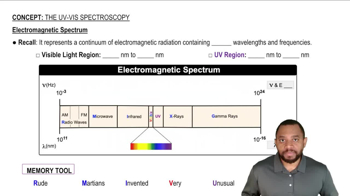
The UV-Vis Spectroscopy Concept 1

Functional Groups

Functional groups are specific groups of atoms within molecules that are responsible for the characteristic chemical reactions of those molecules. Common functional groups include alcohols, amines, carboxylic acids, and alkynes, each exhibiting unique IR absorption patterns. Identifying these groups in the molecules pent-1-yne, diethylamine, and pentanoic acid is crucial for predicting their IR spectra.
Recommended video:
Guided course
02:36
Identifying Functional Groups

Vibrational Modes

Vibrational modes refer to the different ways in which the atoms in a molecule can move relative to each other, such as stretching and bending. Each type of vibration corresponds to specific energy levels, which are reflected in the IR spectrum as absorption peaks. Recognizing the vibrational modes associated with the functional groups in the given molecules helps in predicting their characteristic IR absorptions.
Recommended video:
Guided course
16:04
General Features of IR Spect