
Ch. 13 - Nuclear Magnetic Resonance Spectroscopy
Wade - Organic Chemistry 9th Edition
Wade9th EditionOrganic ChemistryISBN: 9780135213728Not the one you use?Change textbook
Chapter 13, Problem 26a

(a) Show which carbon atoms correspond with which peaks in the 13C NMR spectrum of butan-2-one (Figure 13-45).
<IMAGE>

Verified step by step guidance
1
Analyze the structure of butan-2-one (CH3COCH2CH3). It contains four distinct carbon environments: the carbonyl carbon (C=O), the methyl group attached to the carbonyl (CH3), the methylene group (CH2), and the terminal methyl group (CH3).
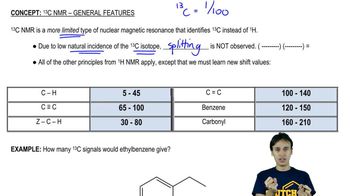
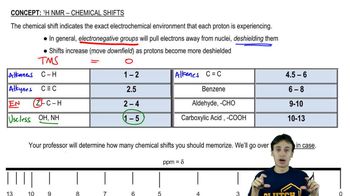
Understand the chemical shift ranges in 13C NMR spectroscopy: the carbonyl carbon typically appears in the range of 160-220 ppm due to its high deshielding, while alkyl carbons (CH3 and CH2) appear in the range of 0-50 ppm.
Identify the peak at approximately 200 ppm in the spectrum. This corresponds to the carbonyl carbon (labeled 'a' in the structure), as it is the most deshielded carbon in butan-2-one.
Locate the peaks in the range of 0-50 ppm. The peak closer to 40 ppm corresponds to the methylene group (CH2, labeled 'b'), while the peak closer to 20 ppm corresponds to the terminal methyl group (CH3, labeled 'c').
The methyl group attached to the carbonyl (CH3, labeled 'a') will also appear in the range of 0-50 ppm, typically near 30 ppm. Assign this peak accordingly.

Verified video answer for a similar problem:

This video solution was recommended by our tutors as helpful for the problem above.
Video duration:
3m
Was this helpful?

Key Concepts

Here are the essential concepts you must grasp in order to answer the question correctly.

13C NMR Spectroscopy

13C NMR (Nuclear Magnetic Resonance) spectroscopy is a technique used to determine the structure of organic compounds by analyzing the magnetic environment of carbon atoms. Each unique carbon environment in a molecule produces a distinct peak in the NMR spectrum, allowing chemists to infer the number and type of carbon atoms present.
Recommended video:
Guided course
04:00
13C NMR General Features

Chemical Shifts

Chemical shifts in NMR spectroscopy refer to the variation in resonance frequency of a nucleus due to its electronic environment. In 13C NMR, these shifts are measured in parts per million (ppm) and provide insight into the hybridization and neighboring groups of carbon atoms, helping to identify their positions in the molecular structure.
Recommended video:
Guided course
11:44
1H NMR Chemical Shifts

Butan-2-one Structure

Butan-2-one, also known as methyl ethyl ketone, has a specific structure with a carbonyl group (C=O) located at the second carbon. Understanding its structure is crucial for correlating the carbon atoms to their respective peaks in the 13C NMR spectrum, as the different environments around the carbon atoms will lead to distinct chemical shifts.
Recommended video:
Guided course
03:04
Drawing Resonance Structures