

Ch. 13 - Nuclear Magnetic Resonance Spectroscopy
Wade - Organic Chemistry 9th Edition
Wade9th EditionOrganic ChemistryISBN: 9780135213728Not the one you use?Change textbook
Chapter 13, Problem 40b

Tell precisely how you would use the proton NMR spectra to distinguish between the following pairs of compounds.
(b)

Verified step by step guidance
1
Step 1: Analyze the molecular structures of the two compounds. The first compound, CH₃CH₂C(O)CH₃, contains an ethyl group (CH₃CH₂-) attached to a carbonyl group (C=O), while the second compound, (CH₃)₂CHC(O)CH₃, contains an isopropyl group ((CH₃)₂CH-) attached to a carbonyl group.
Step 2: Consider the proton environments in each compound. In CH₃CH₂C(O)CH₃, the ethyl group will produce two distinct signals in the proton NMR spectrum: one for the CH₃ protons and one for the CH₂ protons. In (CH₃)₂CHC(O)CH₃, the isopropyl group will produce two distinct signals: one for the CH₃ protons and one for the CH proton.
Step 3: Examine the splitting patterns. In CH₃CH₂C(O)CH₃, the CH₃ protons will appear as a triplet due to coupling with the adjacent CH₂ group, and the CH₂ protons will appear as a quartet due to coupling with the CH₃ group. In (CH₃)₂CHC(O)CH₃, the CH₃ protons will appear as a doublet due to coupling with the CH proton, and the CH proton will appear as a multiplet due to coupling with the two CH₃ groups.
Step 4: Compare the chemical shifts. The CH₂ protons in CH₃CH₂C(O)CH₃ will have a distinct chemical shift due to their proximity to the carbonyl group. In (CH₃)₂CHC(O)CH₃, the CH proton will have a unique chemical shift due to its position in the isopropyl group and proximity to the carbonyl group.
Step 5: Use integration to confirm the number of protons in each environment. In CH₃CH₂C(O)CH₃, the integration will show a 3:2 ratio for the CH₃ and CH₂ protons, respectively. In (CH₃)₂CHC(O)CH₃, the integration will show a 6:1 ratio for the CH₃ and CH protons, respectively.

Verified video answer for a similar problem:

This video solution was recommended by our tutors as helpful for the problem above.
Video duration:
2m
Was this helpful?

Key Concepts

Here are the essential concepts you must grasp in order to answer the question correctly.

Proton NMR Spectroscopy

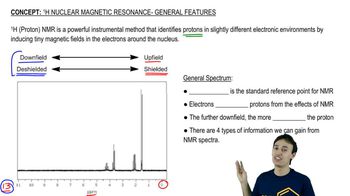
Proton Nuclear Magnetic Resonance (NMR) spectroscopy is a powerful analytical technique used to determine the structure of organic compounds. It provides information about the number of hydrogen atoms in different environments within a molecule, allowing chemists to infer connectivity and functional groups. The chemical shifts, multiplicity, and integration of peaks in the NMR spectrum are crucial for distinguishing between similar compounds.
Recommended video:
Guided course
10:06
General NMR Features

Chemical Shifts

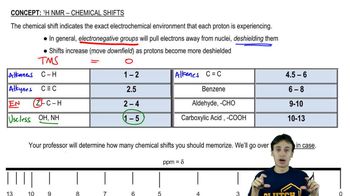
Chemical shifts in NMR spectroscopy refer to the resonance frequency of a nucleus relative to a standard in a magnetic field. They are influenced by the electronic environment surrounding the hydrogen atoms, which can vary significantly between different functional groups. For example, protons adjacent to electronegative atoms or in different hybridization states will resonate at different chemical shifts, aiding in the identification of specific molecular structures.
Recommended video:
Guided course
11:44
1H NMR Chemical Shifts

Multiplicity and Integration

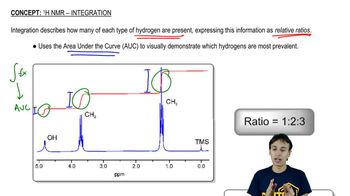
Multiplicity in NMR refers to the splitting of NMR signals due to spin-spin coupling between neighboring hydrogen atoms, which provides insight into the number of adjacent protons. Integration, on the other hand, quantifies the area under each peak, indicating the relative number of protons contributing to that signal. Together, these features help distinguish between compounds with similar structures by revealing differences in their hydrogen environments.
Recommended video:
Guided course
06:46
1H NMR Integration
Related Practice
Textbook Question

A small pilot plant was adding bromine across the double bond of but-2-ene to make 2,3-dibromobutane. A controller malfunction allowed the reaction temperature to rise beyond safe limits. A careful distillation of the product showed that several impurities had formed, including the one having the NMR spectra that appear below. Determine its structure, and assign the peaks to the protons in your structure.

<IMAGE>

1526
views
Textbook Question

Tell precisely how you would use the proton NMR spectra to distinguish between the following pairs of compounds.

(a) 1-bromopropane and 2-bromopropane

1820
views
1
rank
Textbook Question

Sketch your predictions of the proton NMR spectra of the following compounds.

(b)

1500
views
Textbook Question

Sketch your predictions of the proton NMR spectra of the following compounds.

(a) CH3–O–CH2CH3

2088
views
Textbook Question

When 2-chloro-2-methylbutane is treated with a variety of strong bases, the products always seem to contain two isomers (A and B) of formula C5H10. When sodium hydroxide is used as the base, isomer A predominates. When potassium tert-butoxide is used as the base, isomer B predominates. The 1H and 13C NMR spectra of A and B are given below.

(a) Determine the structures of isomers A and B.

(b) Explain why A is the major product when using sodium hydroxide as the base and why B is the major product when using potassium tert-butoxide as the base.

<IMAGE>

2463
views
Textbook Question

(A true story.) A major university was designated as a national nuclear magnetic resonance center by the National Science Foundation. Several large superconducting instruments were being installed when a government safety inspector appeared and demanded to know what provisions were being made to handle the nuclear waste produced by these instruments. Assume you are the manager of the NMR center, and offer an explanation that could be understood by a nonscientist.

1428
views