
Ch. 14 - Ethers, Epoxides, and Thioethers
Wade - Organic Chemistry 9th Edition
Wade9th EditionOrganic ChemistryISBN: 9780135213728Not the one you use?Change textbook
Chapter 14, Problem 50a,b

Propylene oxide is a chiral molecule. Hydrolysis of propylene oxide gives propylene glycol, another chiral molecule.
(a) Draw the enantiomers of propylene oxide.
(b) Propose a mechanism for the acid-catalyzed hydrolysis of pure (R)-propylene oxide.

Verified step by step guidance
1
Step 1: Understand the structure of propylene oxide. Propylene oxide is a three-membered cyclic ether (epoxide) with one chiral center. Its enantiomers are (R)-propylene oxide and (S)-propylene oxide. To draw the enantiomers, depict the molecule with the oxygen atom in the ring and the substituents (methyl group and hydrogen) arranged around the chiral center. Use wedge and dash bonds to indicate stereochemistry.
Step 2: Recall the concept of enantiomers. Enantiomers are non-superimposable mirror images of each other. When drawing the enantiomers of propylene oxide, ensure that the (R)- and (S)-configurations are correctly assigned based on the Cahn-Ingold-Prelog priority rules.
Step 3: For part (b), identify the acid-catalyzed hydrolysis mechanism. Acid catalysis involves protonation of the epoxide oxygen, making the ring more electrophilic and susceptible to nucleophilic attack by water. The mechanism proceeds through ring opening, forming a diol (propylene glycol).
Step 4: Break down the mechanism into steps. (1) Protonation of the epoxide oxygen by the acid catalyst. (2) Nucleophilic attack by water on the more substituted carbon of the epoxide ring (due to regioselectivity). (3) Deprotonation of the intermediate to yield the final product, propylene glycol.
Step 5: Consider stereochemical outcomes. Since the starting material is pure (R)-propylene oxide, the hydrolysis will produce a mixture of diastereomers of propylene glycol due to the formation of a new chiral center during the ring-opening step. Draw the possible stereoisomers of propylene glycol formed in the reaction.

Verified video answer for a similar problem:

This video solution was recommended by our tutors as helpful for the problem above.
Video duration:
2m
Was this helpful?

Key Concepts

Here are the essential concepts you must grasp in order to answer the question correctly.

Chirality

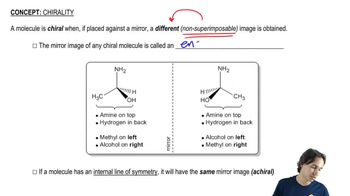
Chirality refers to the geometric property of a molecule that makes it non-superimposable on its mirror image, much like left and right hands. Chiral molecules typically have at least one carbon atom bonded to four different substituents, leading to two distinct enantiomers. Understanding chirality is crucial for analyzing the behavior of molecules in biological systems and their interactions.
Recommended video:
Guided course
05:10
What is chirality?

Enantiomers

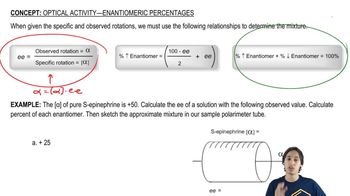
Enantiomers are a pair of chiral molecules that are mirror images of each other. They possess identical physical properties in an achiral environment but can exhibit different biological activities and reactivities. Recognizing the enantiomers of propylene oxide is essential for understanding its chemical behavior and the implications of its hydrolysis.
Recommended video:
Guided course
03:23
How to solve for the percentage of each enantiomer.

Acid-Catalyzed Hydrolysis

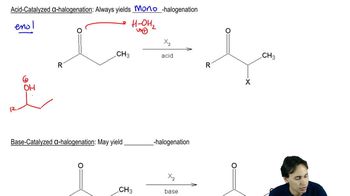
Acid-catalyzed hydrolysis is a reaction where water is used to break chemical bonds in the presence of an acid, facilitating the conversion of a compound into its corresponding alcohol or acid. In the case of propylene oxide, this mechanism involves protonation of the epoxide oxygen, followed by nucleophilic attack by water, leading to the formation of propylene glycol. Understanding this mechanism is vital for predicting the reaction pathway and the stereochemical outcomes.
Recommended video:
Guided course
03:09
Acid Catalyzed
Related Practice
Textbook Question

One of the crowning achievements of natural products synthesis was Bryostatin 1, published by Professor Gary Keck (University of Utah; Journal of the American Chemical Society, 2011, 133, 744–747). The Bryostatins are a family of compounds isolated from aquatic invertebrates known as Bryozoans. The compounds are of interest for a variety of biological effects, including anti-cancer activity and reversing brain damage in rodents.

(d) How many chiral centers are in this molecule?

(e) Using the number of chiral centers you reported in part (d), calculate the number of stereoisomers possible at these chiral centers. (Ignore stereoisomers at double bonds.)

1262
views
Textbook Question

There are two different ways of making 2-ethoxyoctane from octan-2-ol using the Williamson ether synthesis. When pure (–)-octan-2-ol of specific rotation -8.24° is treated with sodium metal and then ethyl iodide, the product is 2-ethoxyoctane with a specific rotation of -15.6°. When pure (–)-octan-2-ol is treated with tosyl chloride and pyridine and then with sodium ethoxide, the product is also 2-ethoxyoctane. Predict the rotation of the 2-ethoxyoctane made using the tosylation/sodium ethoxide procedure, and propose a detailed mechanism to support your prediction.

1080
views
Textbook Question

An acid-catalyzed reaction was carried out using methyl cellosolve (2-methoxyethanol) as the solvent. When the 2-methoxyethanol was redistilled, a higher-boiling fraction (bp 162°C) was also recovered. The mass spectrum of this fraction showed the molecular weight to be 134. The IR and NMR spectra are shown here. Determine the structure of this compound, and propose a mechanism for its formation.

<IMAGE>

1388
views
Textbook Question

A compound of molecular formula C8H8O gives the IR and NMR spectra shown here. Propose a structure, and show how it is consistent with the observed absorptions.

<IMAGE>

3985
views
Textbook Question

Under the right conditions, the following acid-catalyzed double cyclization proceeds in remarkably good yields. Propose a mechanism. Does this reaction resemble a biological process you have seen? 

944
views
Textbook Question

Show how you would convert 3-bromocyclohexanol to the following diol. You may use any additional reagents you need.

1173
views