


Ch. 15 - Conjugated Systems, Orbital Symmetry, and Ultraviolet Spectroscopy
Wade - Organic Chemistry 9th Edition
Wade9th EditionOrganic ChemistryISBN: 9780135213728Not the one you use?Change textbook
Chapter 15, Problem 27d

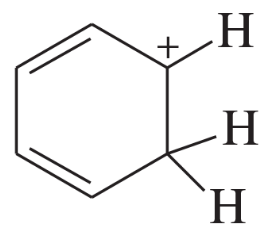
Draw the important resonance contributors for the following cations, anions, and radicals.
(d)

Verified step by step guidance
1
Identify the structure of the given species (cation, anion, or radical) and locate any atoms with lone pairs, π-bonds, or unfilled octets. These features are key to determining resonance contributors.
Determine the movement of electrons. For resonance structures, electrons can move in the form of lone pairs or π-bonds. Use curved arrows to show the electron flow. For example, a lone pair can form a π-bond, or a π-bond can shift to form a lone pair or move to an adjacent atom.
Draw the new resonance structure after the electron movement. Ensure that all atoms obey the octet rule (if applicable) and that the overall charge of the molecule remains the same.
Repeat the process to identify all possible resonance contributors. Each contributor should differ only in the placement of electrons, not the arrangement of atoms.
Evaluate the stability of each resonance structure. More stable contributors (e.g., those with full octets, minimal formal charges, or charges on more electronegative atoms) will contribute more to the resonance hybrid.

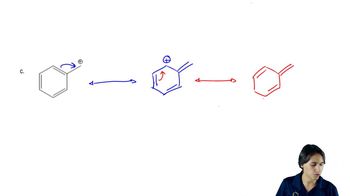
Verified video answer for a similar problem:

This video solution was recommended by our tutors as helpful for the problem above.
Video duration:
3m
Was this helpful?

Key Concepts

Here are the essential concepts you must grasp in order to answer the question correctly.

Resonance Structures

Resonance structures are different Lewis structures for the same molecule that depict the delocalization of electrons. They help illustrate how the actual structure is a hybrid of these forms, providing insight into the molecule's stability and reactivity. Understanding resonance is crucial for predicting the behavior of cations, anions, and radicals.
Recommended video:
Guided course
03:04
Drawing Resonance Structures

Cation, Anion, and Radical Stability

The stability of cations, anions, and radicals is influenced by their electronic structure and the presence of resonance. Cations are stabilized by electron-donating groups, while anions benefit from electron-withdrawing groups. Radicals, having an unpaired electron, are stabilized by resonance as well, which can distribute the unpaired electron over multiple atoms.
Recommended video:
Guided course
03:43
The radical stability trend.

Electrophiles and Nucleophiles

Electrophiles are species that seek electrons and are typically positively charged or electron-deficient, while nucleophiles are electron-rich species that donate electrons. Understanding the roles of these species is essential when analyzing resonance contributors, as they can influence the stability and reactivity of cations, anions, and radicals in organic reactions.
Recommended video:
Guided course
03:
Nucleophile or Electrophile