Ch. 15 - Conjugated Systems, Orbital Symmetry, and Ultraviolet Spectroscopy
Wade - Organic Chemistry 9th Edition
Wade9th EditionOrganic ChemistryISBN: 9780135213728Not the one you use?Change textbook
Chapter 15, Problem 14d

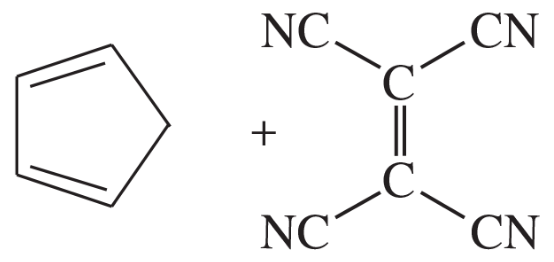
Predict the products of the following proposed Diels–Alder reactions.
(d)

Verified step by step guidance
1
Step 1: Identify the reactants in the Diels–Alder reaction. The first reactant is cyclopentadiene, which acts as the diene. The second reactant is a molecule with a central alkene and aldehyde groups attached, which acts as the dienophile.
Step 2: Recall the mechanism of the Diels–Alder reaction. This reaction involves a [4+2] cycloaddition where the diene (cyclopentadiene) and the dienophile (the molecule with aldehyde groups) combine to form a new six-membered ring.
Step 3: Analyze the electron-withdrawing groups on the dienophile. The aldehyde groups (-CHO) are electron-withdrawing, which makes the dienophile more reactive in the Diels–Alder reaction by stabilizing the transition state.
Step 4: Predict the regiochemistry and stereochemistry of the product. The reaction will form a six-membered ring with the aldehyde groups positioned based on the orientation of the dienophile relative to the diene. Consider the endo rule, which favors the formation of the product where the electron-withdrawing groups are oriented towards the newly formed π-system.
Step 5: Draw the product structure. The product will be a bicyclic compound with a six-membered ring fused to the original five-membered ring of cyclopentadiene. The aldehyde groups will be attached to the six-membered ring in positions determined by the reaction's stereochemistry.

Verified video answer for a similar problem:

This video solution was recommended by our tutors as helpful for the problem above.
Video duration:
3m
Was this helpful?

Key Concepts

Here are the essential concepts you must grasp in order to answer the question correctly.

Diels–Alder Reaction

The Diels–Alder reaction is a [4+2] cycloaddition reaction between a conjugated diene and a dienophile, resulting in the formation of a six-membered ring. This reaction is a key method in organic synthesis for constructing cyclic compounds and is characterized by its stereospecificity and regioselectivity, meaning the orientation of substituents on the reactants influences the product's structure.
Recommended video:
Guided course
04:02
Diels-Alder Retrosynthesis

Diene and Dienophile

In the context of the Diels–Alder reaction, a diene is a molecule containing two double bonds, which can participate in the reaction by forming new bonds with the dienophile. The dienophile is typically an alkene or alkyne that is electron-deficient, making it reactive towards the electron-rich diene. Understanding the nature of these components is crucial for predicting the reaction products.
Recommended video:
Guided course
04:43
Drawing MO Diagram for Dienes

Stereochemistry

Stereochemistry refers to the spatial arrangement of atoms in molecules and how this affects their chemical behavior. In Diels–Alder reactions, the stereochemistry of the reactants influences the stereochemical outcome of the products, leading to specific configurations (cis or trans) in the resulting cyclohexene derivatives. Analyzing the stereochemical implications is essential for accurately predicting the products.
Recommended video:
1:38
Polymer Stereochemistry Concept 1