Ch. 15 - Conjugated Systems, Orbital Symmetry, and Ultraviolet Spectroscopy
Wade - Organic Chemistry 9th Edition
Wade9th EditionOrganic ChemistryISBN: 9780135213728Not the one you use?Change textbook
Chapter 15, Problem 19

Show that the [4 + 2] Diels–Alder reaction is photochemically forbidden.

Verified step by step guidance
1
Understand the Diels–Alder reaction: The [4 + 2] cycloaddition is a pericyclic reaction where a conjugated diene (4 π-electrons) reacts with a dienophile (2 π-electrons) to form a six-membered ring. It typically proceeds via a concerted mechanism.
Recall the Woodward–Hoffmann rules: These rules determine whether a pericyclic reaction is thermally or photochemically allowed based on the conservation of orbital symmetry. For the Diels–Alder reaction, the reaction is thermally allowed if it proceeds via a suprafacial interaction of the π-electrons.
Analyze the π-electron system under photochemical conditions: When the system is exposed to light, one of the π-electrons in the diene or dienophile is excited to a higher energy state. This changes the electronic configuration and alters the symmetry of the molecular orbitals.
Apply the Woodward–Hoffmann rules for photochemical conditions: Under photochemical excitation, the reaction involves an excited state where the symmetry of the molecular orbitals no longer supports a suprafacial interaction of the π-electrons. This makes the reaction photochemically forbidden.
Conclude based on orbital symmetry: The [4 + 2] Diels–Alder reaction is photochemically forbidden because the conservation of orbital symmetry is violated in the excited state, preventing the reaction from proceeding under photochemical conditions.

Verified video answer for a similar problem:

This video solution was recommended by our tutors as helpful for the problem above.
Video duration:
11m
Was this helpful?

Key Concepts

Here are the essential concepts you must grasp in order to answer the question correctly.

Diels–Alder Reaction

The Diels–Alder reaction is a cycloaddition reaction between a conjugated diene and a dienophile, forming a six-membered ring. It is a [4 + 2] cycloaddition, where four π electrons from the diene and two π electrons from the dienophile are involved. This reaction is widely used in organic synthesis due to its ability to create complex cyclic structures efficiently.
Recommended video:
Guided course
04:02
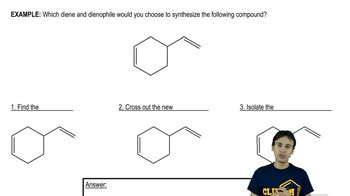
Diels-Alder Retrosynthesis

Orbital Symmetry

Orbital symmetry refers to the symmetry properties of molecular orbitals involved in a reaction. According to the Woodward-Hoffmann rules, reactions can be classified as allowed or forbidden based on the symmetry of the interacting orbitals. In the case of the Diels–Alder reaction, the symmetry of the diene and dienophile's orbitals must match for the reaction to proceed, which is crucial for understanding its photochemical behavior.
Recommended video:
Guided course
00:25
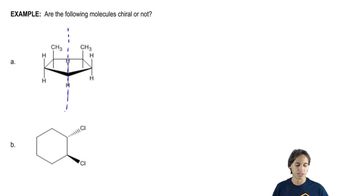
Determining Chirality with Plane of Symmetry

Photochemical Reactions

Photochemical reactions involve the absorption of light, leading to changes in the electronic state of molecules. These reactions can alter the symmetry and energy of molecular orbitals, potentially allowing or forbidding certain pathways. In the context of the Diels–Alder reaction, the photochemical conditions can disrupt the orbital symmetry required for the reaction to occur, rendering it photochemically forbidden.
Recommended video:
Guided course
09:36
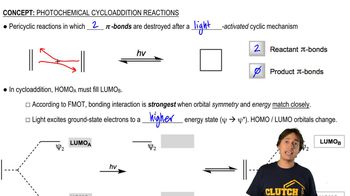
MO Theory of Photochemical Cycloadditions