
Ch. 16 - Aromatic Compounds
Wade - Organic Chemistry 9th Edition
Wade9th EditionOrganic ChemistryISBN: 9780135213728Not the one you use?Change textbook
Chapter 16, Problem 46

An unknown compound gives the following mass, IR, and NMR spectra. Propose a structure, and show how it is consistent with the spectra. Show the fragmentations that give the prominent peaks at m/z 127 and 155 in the mass spectrum.
<IMAGES>

Verified step by step guidance
1
Step 1: Analyze the NMR spectrum provided. The peaks at 8-7 ppm suggest the presence of aromatic protons, indicating an aromatic ring. The integration values (2H, 1H, 2H) correspond to the number of protons in different environments within the aromatic system. The peak at 2 ppm (3H) suggests the presence of a methyl group attached to the aromatic ring.
Step 2: Examine the IR spectrum (not shown in the image but typically provided in such problems). Look for characteristic absorption bands. For example, a strong band around 1700 cm⁻¹ would indicate a carbonyl group, while bands around 3000 cm⁻¹ would suggest C-H stretching in aromatic or alkyl groups.
Step 3: Analyze the mass spectrum data. The prominent peaks at m/z 127 and 155 suggest specific fragmentations. For m/z 127, consider the loss of a methyl group (15 amu) from the molecular ion. For m/z 155, consider the molecular ion itself or a fragment that retains the aromatic ring and substituents.
Step 4: Propose a structure consistent with the data. Based on the NMR spectrum, the compound likely contains an aromatic ring with substituents such as a methyl group. The IR spectrum (if available) would confirm the presence of functional groups like a carbonyl or hydroxyl group.
Step 5: Verify the proposed structure by matching it to the spectral data. Ensure the NMR chemical shifts, integration values, and splitting patterns align with the structure. Confirm the fragmentations observed in the mass spectrum by considering plausible cleavage pathways.

Verified video answer for a similar problem:

This video solution was recommended by our tutors as helpful for the problem above.
Video duration:
4m
Was this helpful?

Key Concepts

Here are the essential concepts you must grasp in order to answer the question correctly.

Mass Spectrometry

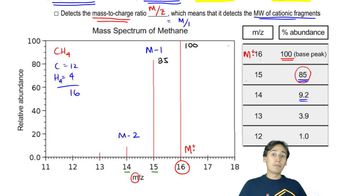
Mass spectrometry is an analytical technique used to measure the mass-to-charge ratio of ions. It provides information about the molecular weight of compounds and their fragmentation patterns. In this context, the prominent peaks at m/z 127 and 155 indicate specific fragment ions, which can help deduce the structure of the unknown compound by analyzing how it breaks apart.
Recommended video:
Guided course
01:25
How to Read a Mass Spectrum

Infrared Spectroscopy (IR)

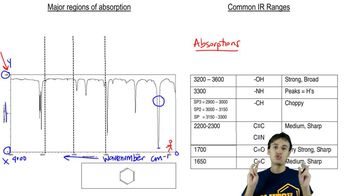
Infrared spectroscopy is a technique that measures the absorption of infrared light by a compound, providing information about its functional groups. Different bonds absorb characteristic wavelengths, allowing chemists to identify specific functional groups present in the compound. Understanding the IR spectrum is crucial for confirming the presence of certain groups that align with the proposed structure.
Recommended video:
Guided course
16:04
General Features of IR Spect

Nuclear Magnetic Resonance (NMR) Spectroscopy

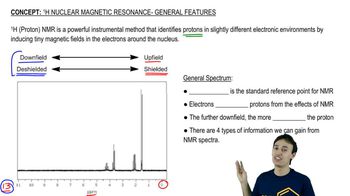
Nuclear Magnetic Resonance (NMR) spectroscopy is a powerful technique used to determine the structure of organic compounds by analyzing the magnetic properties of atomic nuclei. The NMR spectrum provides information about the number of hydrogen atoms in different environments, as indicated by the peaks and their integrations. This data is essential for deducing the connectivity and arrangement of atoms in the unknown compound.
Recommended video:
Guided course
10:06
General NMR Features
Related Practice
Textbook Question

The ribonucleosides that make up ribonucleic acid (RNA) are composed of D-ribose (a sugar) and four heterocyclic “bases.” The general structure of a ribonucleoside is shown here.

The four heterocyclic bases are cytosine, uracil, guanine, and adenine. Cytosine and uracil are called pyrimidine bases because their structures resemble pyrimidine. Guanine and adenine are called purine bases because their structures resemble purine.

c. Do any of these bases have easily formed tautomers that are aromatic? (Consider moving a proton from nitrogen to a carbonyl group to form a phenolic derivative.)

697
views
Textbook Question

The ribonucleosides that make up ribonucleic acid (RNA) are composed of D-ribose (a sugar) and four heterocyclic “bases.” The general structure of a ribonucleoside is shown here.

The four heterocyclic bases are cytosine, uracil, guanine, and adenine. Cytosine and uracil are called pyrimidine bases because their structures resemble pyrimidine. Guanine and adenine are called purine bases because their structures resemble purine.

b. Predict which nitrogen atoms are basic.

620
views
Textbook Question

Hexahelicene seems a poor candidate for optical activity because all its carbon atoms are sp2 hybrids and presumably flat. Nevertheless, hexahelicene has been synthesized and separated into enantiomers. Its optical rotation is enormous: [α]D = 3700°. Explain why hexahelicene is optically active, and speculate as to why the rotation is so large.

747
views
Textbook Question

Chlorophyll is the general name for a family of compounds present in algae and green plants. These molecules use the energy in sunlight to convert carbon dioxide and water into carbohydrates and other energy sources. At the heart of chlorophyll (shown below) is a large-ring magnesium complex called a chlorin. Circle each double bond in the large cyclic conjugated pi system that makes it aromatic. How many pi electrons are in this aromatic system?

996
views
Textbook Question

Consider the following compound, which has been synthesized and characterized:

a. Assuming this molecule is entirely conjugated, do you expect it to be aromatic, antiaromatic, or nonaromatic?

b. Why was this molecule synthesized with three tert-butyl substituents? Why not make the unsubstituted compound and study it instead?

818
views