Show the product of the Diels–Alder dimerization of cyclobutadiene. (This reaction is similar to the dimerization of cyclopentadiene, discussed in Section 15-11.)
Ch. 16 - Aromatic Compounds
Chapter 16, Problem 5
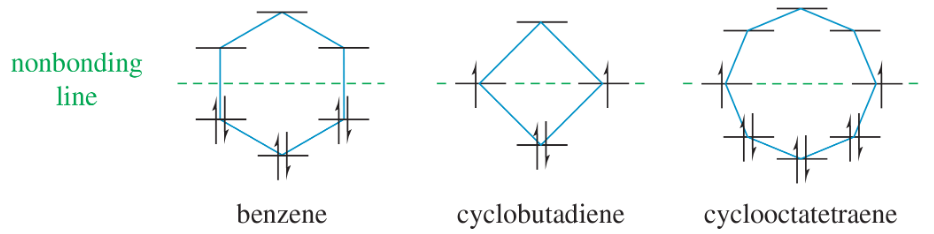
Does the MO energy diagram of cyclooctatetraene (Figure 16-8) appear to be a particularly stable or unstable configuration? Explain.

Verified step by step guidance1
Examine the molecular orbital (MO) energy diagram provided for cyclooctatetraene. Note the arrangement of energy levels and the distribution of electrons in the orbitals.
Cyclooctatetraene has 8 π-electrons, which are distributed across the molecular orbitals. Observe that the electrons fill the lower-energy bonding orbitals first, following the Aufbau principle.
The diagram shows that the bonding orbitals are fully occupied, while the non-bonding and anti-bonding orbitals remain unoccupied. This suggests that cyclooctatetraene does not exhibit aromatic stability, as it does not follow Hückel's rule (4n+2 π-electrons for aromaticity).
The cyclic structure of cyclooctatetraene is not planar, which further prevents delocalization of π-electrons across the ring. This lack of delocalization contributes to its instability compared to aromatic compounds.
Conclude that the MO energy diagram indicates cyclooctatetraene is not particularly stable due to the absence of aromatic stabilization and the presence of higher-energy non-bonding orbitals.

Verified video answer for a similar problem:
This video solution was recommended by our tutors as helpful for the problem above.
Video duration:
4mWas this helpful?
Key Concepts
Here are the essential concepts you must grasp in order to answer the question correctly.
Molecular Orbital Theory
Molecular Orbital (MO) Theory describes the behavior of electrons in molecules by combining atomic orbitals to form molecular orbitals. These orbitals can be bonding, antibonding, or non-bonding, and their energy levels determine the stability of the molecule. In cyclooctatetraene, the arrangement of these orbitals influences its overall stability and reactivity.
Hückel's Rule
Hückel's Rule states that a planar, cyclic molecule is aromatic and particularly stable if it has 4n + 2 π electrons, where n is a non-negative integer. Cyclooctatetraene, with 8 π electrons, does not satisfy this rule, leading to its classification as non-aromatic and contributing to its instability compared to aromatic compounds.
Conjugation and Stability
Conjugation refers to the overlap of p-orbitals across adjacent bonds, allowing for delocalization of π electrons. In cyclooctatetraene, the lack of effective conjugation due to its non-planar structure results in a higher energy state and lower stability. This instability is reflected in its molecular orbital diagram, which shows a significant energy gap between bonding and antibonding orbitals.
Related Practice
Textbook Question
1054
views
Textbook Question
Make a model of cyclooctatetraene in the tub conformation. Draw this conformation, and estimate the angle between the p orbitals of adjacent pi bonds.
1299
views
Textbook Question
Classify the following compounds as aromatic, antiaromatic, or nonaromatic.
(c)
(d)
1726
views
Textbook Question
a. Draw the resonance forms of benzene, cyclobutadiene, and cyclooctatetraene, showing all the carbon and hydrogen atoms.
b. Assuming that these molecules are all planar, show how the p orbitals on the sp2 hybrid carbon atoms form continuous rings of overlapping orbitals above and below the plane of the carbon atoms.
1002
views
Textbook Question
Classify the following compounds as aromatic, antiaromatic, or nonaromatic.
(a)
(b)
1090
views
Textbook Question
Using the information in Figure 16-2, calculate the values of ∆H° for the following reactions:
(c)
605
views