
Ch. 16 - Aromatic Compounds
Wade - Organic Chemistry 9th Edition
Wade9th EditionOrganic ChemistryISBN: 9780135213728Not the one you use?Change textbook
Chapter 16, Problem 38

For each NMR spectrum, propose a structure consistent with the spectrum and the additional information provided.
<IMAGE>
a. Elemental analysis shows the molecular formula to be C8H7OCl. The IR spectrum shows a moderate absorption at 1602 cm–1 and a strong absorption at 1690 cm–1.
b. The mass spectrum shows a double molecular ion of ratio 1:1 at m/z 184 and 186.
<IMAGE>

Verified step by step guidance
1
Step 1: Analyze the molecular formula C8H7OCl provided in the problem. This indicates the presence of 8 carbons, 7 hydrogens, 1 oxygen, and 1 chlorine atom. The chlorine atom suggests the possibility of isotopic peaks in the mass spectrum due to its natural abundance (35Cl and 37Cl).
Step 2: Examine the IR spectrum data. The absorption at 1602 cm⁻¹ suggests the presence of a C=C bond, likely in an aromatic ring. The strong absorption at 1690 cm⁻¹ indicates a carbonyl group (C=O), which is consistent with the molecular formula.
Step 3: Analyze the mass spectrum data. The double molecular ion peaks at m/z 184 and 186 in a 1:1 ratio confirm the presence of chlorine, as the isotopes 35Cl and 37Cl contribute to this pattern.
Step 4: Interpret the NMR spectrum. The peaks at approximately 7-8 ppm correspond to aromatic protons, indicating the presence of an aromatic ring. The integration values (2H, 2H, 1H) suggest specific proton environments within the aromatic ring. The peak at approximately 4 ppm corresponds to 2H, likely from a CH2 group adjacent to an electronegative atom or group.
Step 5: Combine all the data. The molecular formula, IR spectrum, mass spectrum, and NMR spectrum suggest a structure with an aromatic ring, a carbonyl group, and a chlorine atom. The aromatic ring likely contains substituents that account for the observed proton environments in the NMR spectrum.

Verified video answer for a similar problem:

This video solution was recommended by our tutors as helpful for the problem above.
Video duration:
6m
Was this helpful?

Key Concepts

Here are the essential concepts you must grasp in order to answer the question correctly.

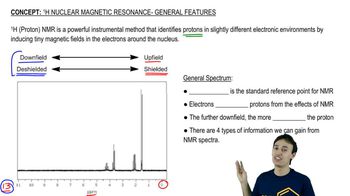
Nuclear Magnetic Resonance (NMR) Spectroscopy

NMR spectroscopy is a powerful analytical technique used to determine the structure of organic compounds. It relies on the magnetic properties of certain nuclei, primarily hydrogen (1H) and carbon (13C), to provide information about the number of hydrogen atoms, their environment, and connectivity in a molecule. Peaks in the NMR spectrum correspond to different chemical environments of protons, and their integration values indicate the relative number of protons contributing to each peak.
Recommended video:
Guided course
10:06
General NMR Features

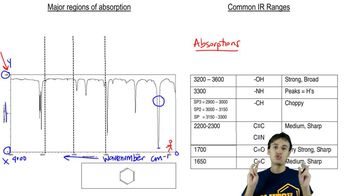
Infrared (IR) Spectroscopy

IR spectroscopy is used to identify functional groups in organic compounds by measuring the absorption of infrared light, which causes molecular vibrations. Specific absorption bands correspond to particular functional groups; for example, a strong absorption around 1690 cm-1 typically indicates a carbonyl (C=O) group, while a moderate absorption at 1602 cm-1 may suggest the presence of an aromatic ring. Understanding these absorptions helps in deducing the functional groups present in the compound.
Recommended video:
Guided course
16:04
General Features of IR Spect

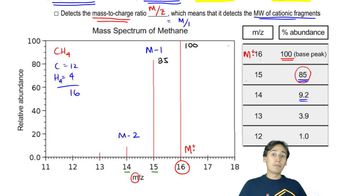
Mass Spectrometry

Mass spectrometry is an analytical technique that measures the mass-to-charge ratio of ions to identify and quantify molecules in a sample. The presence of a double molecular ion at m/z 184 and 186 suggests isotopic variants of the same compound, likely due to the presence of chlorine, which has isotopes with different masses. This information, combined with the molecular formula and other spectral data, aids in confirming the molecular structure of the compound.
Recommended video:
Guided course
01:25
How to Read a Mass Spectrum
Related Practice
Textbook Question

Biphenyl has the following structure.

c. The heat of hydrogenation for biphenyl is about 418 kJ/mol (100 kcal/mol). Calculate the resonance energy of biphenyl.

d. Compare the resonance energy of biphenyl with that of naphthalene and with that of two benzene rings. Explain the difference in the resonance energies of naphthalene and biphenyl.

1276
views
Textbook Question

Before spectroscopy was invented, Körner’s absolute method was used to determine whether a disubstituted benzene derivative was the ortho, meta, or para isomer. Körner’s method involves adding a third group (often a nitro group) and determining how many isomers are formed. For example, when o-xylene is nitrated (by a method shown in Chapter 17), two isomers are formed.

a. How many isomers are formed by nitration of m-xylene?

1094
views
Textbook Question

Biphenyl has the following structure.

a. Is biphenyl a (fused) polynuclear aromatic hydrocarbon?

b. How many pi electrons are there in the two aromatic rings of biphenyl? How does this number compare with that for naphthalene?

1440
views
Textbook Question

Before spectroscopy was invented, Körner’s absolute method was used to determine whether a disubstituted benzene derivative was the ortho, meta, or para isomer. Körner’s method involves adding a third group (often a nitro group) and determining how many isomers are formed. For example, when o-xylene is nitrated (by a method shown in Chapter 17), two isomers are formed.

c. A turn-of-the-century chemist isolated an aromatic compound of molecular formula C6H4Br2. He carefully nitrated this compound and purified three isomers of formula C6H3Br2NO2. Propose structures for the original compound and the three nitrated derivatives

642
views
Textbook Question

Recall (Section 16-10) that two positions of anthracene sometimes react more like polyenes than like aromatic compounds.

b. The Diels–Alder reaction of anthracene with maleic anhydride is a common organic lab experiment. Predict the product of this Diels–Alder reaction.

766
views
Textbook Question

Before spectroscopy was invented, Körner’s absolute method was used to determine whether a disubstituted benzene derivative was the ortho, meta, or para isomer. Körner’s method involves adding a third group (often a nitro group) and determining how many isomers are formed. For example, when o-xylene is nitrated (by a method shown in Chapter 17), two isomers are formed.

b. How many isomers are formed by nitration of p-xylene?

831
views