Ch. 16 - Aromatic Compounds
Wade - Organic Chemistry 9th Edition
Wade9th EditionOrganic ChemistryISBN: 9780135213728Not the one you use?Change textbook
Chapter 16, Problem 8

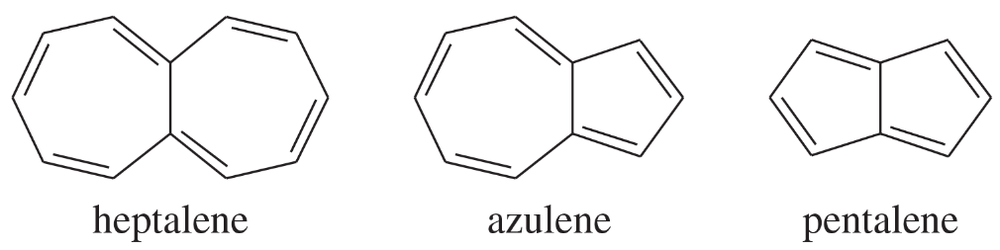
One of the following compounds is much more stable than the other two. Classify each as aromatic, antiaromatic, or nonaromatic.

Verified step by step guidance
1
Step 1: Recall the criteria for aromaticity. A compound is aromatic if it satisfies the following conditions: (1) It is cyclic, (2) It is planar, (3) It has a conjugated π-electron system, and (4) It follows Hückel's rule, which states that the molecule must have (4n + 2) π-electrons, where n is a non-negative integer.
Step 2: Analyze heptalene. Heptalene is cyclic and conjugated, but it does not satisfy Hückel's rule because it has 8 π-electrons, which is not of the form (4n + 2). Instead, it falls under the category of antiaromatic compounds because it has (4n) π-electrons and is planar.
Step 3: Analyze azulene. Azulene is cyclic, planar, and conjugated. It has 10 π-electrons, which satisfies Hückel's rule (4n + 2, where n = 2). Therefore, azulene is aromatic and much more stable due to aromatic stabilization.
Step 4: Analyze pentalene. Pentalene is cyclic and conjugated, but it has 8 π-electrons, which does not satisfy Hückel's rule. Additionally, it is antiaromatic because it has (4n) π-electrons and is planar, leading to instability.
Step 5: Conclude the classification. Heptalene and pentalene are antiaromatic and unstable, while azulene is aromatic and much more stable due to aromatic stabilization.

Verified video answer for a similar problem:

This video solution was recommended by our tutors as helpful for the problem above.
Video duration:
8m
Was this helpful?

Key Concepts

Here are the essential concepts you must grasp in order to answer the question correctly.

Aromaticity

Aromatic compounds are cyclic, planar molecules with a ring of resonance that follow Hückel's rule, which states they must have 4n + 2 π electrons (where n is a non-negative integer). This unique electron configuration leads to increased stability due to delocalization of electrons across the ring, making aromatic compounds particularly stable compared to nonaromatic and antiaromatic compounds.
Recommended video:
Guided course
08:19
Intro to Aromaticity

Antiaromaticity

Antiaromatic compounds are also cyclic and planar but contain 4n π electrons, which leads to instability due to the unfavorable electron delocalization. This instability arises because the electron configuration does not satisfy Hückel's rule, resulting in increased energy and reactivity compared to both aromatic and nonaromatic compounds.
Recommended video:
Guided course
02:58
Determine the aromaticity

Nonaromaticity

Nonaromatic compounds do not meet the criteria for aromaticity or antiaromaticity. They may be acyclic, lack planarity, or have an insufficient number of π electrons. As a result, nonaromatic compounds typically exhibit stability levels that fall between aromatic and antiaromatic compounds, depending on their specific structural features.
Related Practice
Textbook Question

Drawpictorialrepresentations (as in Figures16-4 and 16-6) for the three bonding MOs and the two nonbonding MOs of cyclooctatetraene. The antibonding MOs are difficult to draw, except for the all-antibonding MO.

790
views

Textbook Question

Make a model of cyclooctatetraene in the tub conformation. Draw this conformation, and estimate the angle between the p orbitals of adjacent pi bonds.

1299
views
Textbook Question

Classify the following compounds as aromatic, antiaromatic, or nonaromatic.

(c)

(d)

1726
views
Textbook Question

(a) Draw the molecular orbitals for the cyclopropenyl case.

(Because there are three p orbitals, there must be three MOs: one all-bonding MO and one degenerate pair of MOs.)

(b) Draw an energy diagram for the cyclopropenyl MOs. (The polygon rule is helpful.) Label each MO as bonding, nonbonding, or antibonding, and add the nonbonding line. Notice that it goes through the approximate average of the MOs.

(c) Add electrons to your energy diagram to show the configuration of the cyclopropenyl cation and the cyclopropenyl anion. Which is aromatic and which is antiaromatic?

1324
views
Textbook Question

a. Use the polygon rule to draw an energy diagram (as in Figures 16-5 and 16-7) for the MOs of a planar cyclooctatetraenyl system.

b. Fill in the eight pi electrons for cyclooctatetraene. Is this electronic configuration aromatic or antiaromatic? Could the cyclooctatetraene system be aromatic if it gained or lost electrons?

764
views
Textbook Question

Classify the following compounds as aromatic, antiaromatic, or nonaromatic.

(a)

(b)

1090
views