Ch. 16 - Aromatic Compounds
Wade - Organic Chemistry 9th Edition
Wade9th EditionOrganic ChemistryISBN: 9780135213728Not the one you use?Change textbook
Chapter 16, Problem 15

The polarization of a carbonyl group can be represented by a pair of resonance structures:
Resonance structures of a carbonyl group, illustrating stability differences in cyclopropenone and cyclopentadienone.
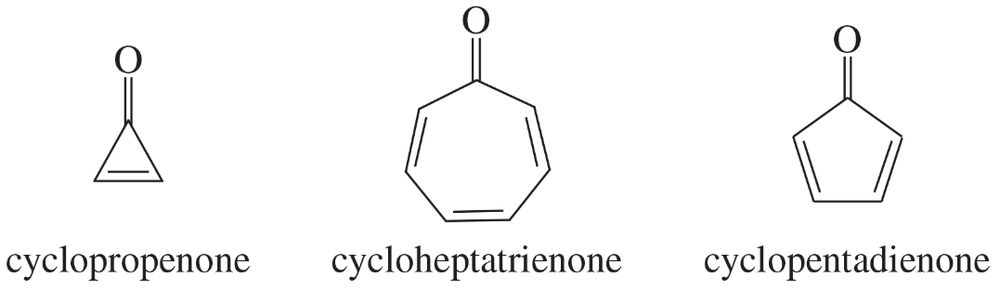
Cyclopropenone and cycloheptatrienone are more stable than anticipated. Cyclopentadienone, however, is relatively unstable and rapidly undergoes a Diels–Alder dimerization. Explain.

Verified step by step guidance
1
Step 1: Begin by analyzing the resonance structures of the carbonyl group. The polarization of the carbonyl group can be represented by two resonance forms: one with a double bond between carbon and oxygen, and another with a positive charge on the carbon and a negative charge on the oxygen. This polarization makes the carbonyl carbon electrophilic and susceptible to nucleophilic attack.
Step 2: Examine the stability of cyclopropenone. Cyclopropenone is stabilized due to aromaticity. The three-membered ring contributes to a delocalized π-electron system, satisfying Hückel's rule (4n+2 π electrons, where n=1). This aromatic stabilization makes cyclopropenone more stable than anticipated.
Step 3: Analyze cycloheptatrienone. Cycloheptatrienone is also stabilized by aromaticity. The seven-membered ring can delocalize its π-electrons, forming a tropylium ion-like structure that satisfies Hückel's rule. This aromatic stabilization contributes to its unexpected stability.
Step 4: Investigate cyclopentadienone. Cyclopentadienone lacks aromatic stabilization because it does not satisfy Hückel's rule for aromaticity. The conjugated π-electron system in the five-membered ring is disrupted by the carbonyl group, leading to instability. This instability drives cyclopentadienone to undergo rapid Diels–Alder dimerization to form more stable products.
Step 5: Conclude by comparing the three compounds. Cyclopropenone and cycloheptatrienone are stabilized by aromaticity, while cyclopentadienone is destabilized due to the lack of aromatic stabilization. The instability of cyclopentadienone explains its tendency to undergo Diels–Alder dimerization.

Verified video answer for a similar problem:

This video solution was recommended by our tutors as helpful for the problem above.
Video duration:
5m
Was this helpful?

Key Concepts

Here are the essential concepts you must grasp in order to answer the question correctly.

Resonance Structures

Resonance structures are different ways of drawing the same molecule that illustrate the delocalization of electrons. In the case of carbonyl groups, resonance helps explain the polarization of the C=O bond, where the double bond can be represented as a hybrid of multiple structures. This delocalization contributes to the stability and reactivity of the compound.
Recommended video:
Guided course
03:04
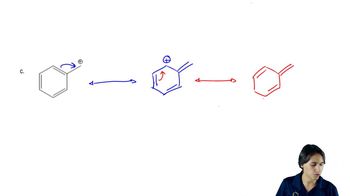
Drawing Resonance Structures

Stability of Cycloalkenes

The stability of cycloalkenes, such as cyclopropenone and cycloheptatrienone, is influenced by factors like ring strain and the degree of conjugation. Cyclopropenone has a three-membered ring that is highly strained but stabilized by resonance, while cycloheptatrienone benefits from extended conjugation. In contrast, cyclopentadienone has a five-membered ring that is less stable due to its inability to effectively delocalize electrons, leading to its rapid dimerization.
Recommended video:
Guided course
03:43
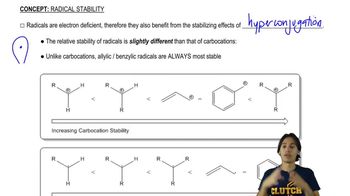
The radical stability trend.

Diels–Alder Reaction

The Diels–Alder reaction is a [4+2] cycloaddition reaction between a diene and a dienophile, forming a six-membered ring. Cyclopentadienone's instability makes it highly reactive, allowing it to quickly undergo this reaction to form more stable products. This reaction is significant in organic synthesis and illustrates how the reactivity of a compound can be influenced by its electronic structure and stability.
Recommended video:
Guided course
04:02
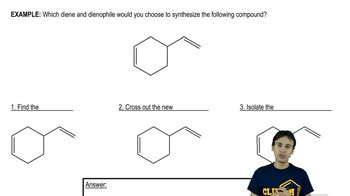
Diels-Alder Retrosynthesis