Ch. 16 - Aromatic Compounds
Wade - Organic Chemistry 9th Edition
Wade9th EditionOrganic ChemistryISBN: 9780135213728Not the one you use?Change textbook
Chapter 16, Problem 25

The UV spectrum of 1-phenylprop-2-en-1-ol shows an intense absorption at 220 nm and a weaker absorption at 258 nm. When this compound is treated with dilute sulfuric acid, it rearranges to an isomer with an intense absorption at 250 nm and a weaker absorption at 290 nm. Suggest a structure for the isomeric product and propose a mechanism for its formation.

Verified step by step guidance
1
Analyze the UV spectrum data: The initial compound, 1-phenylprop-2-en-1-ol, shows an intense absorption at 220 nm and a weaker absorption at 258 nm. These absorptions suggest the presence of a conjugated system, likely involving the phenyl group and the alkene. The isomeric product shows an intense absorption at 250 nm and a weaker absorption at 290 nm, indicating an extended conjugation in the product.
Propose the structural change: The treatment with dilute sulfuric acid suggests an acid-catalyzed reaction. A plausible structural change is the rearrangement of the allylic alcohol (1-phenylprop-2-en-1-ol) to a conjugated ketone or enone. This would extend the conjugation, consistent with the UV spectrum of the product.
Propose the mechanism: The reaction likely proceeds via an acid-catalyzed dehydration and rearrangement. First, protonation of the hydroxyl group (-OH) by sulfuric acid forms a good leaving group (water).
Detail the rearrangement: After the loss of water, a carbocation intermediate is formed. This carbocation can undergo resonance stabilization involving the phenyl group and the alkene. A 1,2-hydride shift may occur to form a more stable carbocation, which is then followed by deprotonation to form the conjugated ketone or enone.
Verify the product structure: The final product should have an extended conjugation system involving the phenyl group and the enone. This structure is consistent with the UV spectrum data, where the intense absorption at 250 nm and weaker absorption at 290 nm indicate a longer conjugated system compared to the starting material.

Verified video answer for a similar problem:

This video solution was recommended by our tutors as helpful for the problem above.
Video duration:
10m
Was this helpful?

Key Concepts

Here are the essential concepts you must grasp in order to answer the question correctly.

UV-Vis Spectroscopy

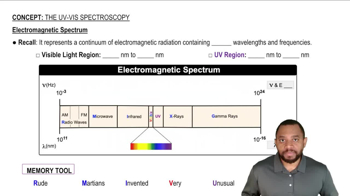
UV-Vis spectroscopy is a technique used to measure the absorption of ultraviolet or visible light by a compound. The wavelengths at which a compound absorbs light can provide insights into its electronic structure, particularly the presence of conjugated systems or functional groups. In this case, the absorption peaks at 220 nm and 258 nm indicate the presence of π-π* transitions, which are characteristic of alkenes and aromatic compounds.
Recommended video:
2:56
The UV-Vis Spectroscopy Concept 1

Rearrangement Mechanisms

Rearrangement mechanisms involve the reorganization of atoms within a molecule to form a new isomer. In organic chemistry, this often occurs through the migration of groups or atoms, typically facilitated by acidic conditions. The treatment of 1-phenylprop-2-en-1-ol with dilute sulfuric acid likely leads to a protonation step followed by a shift of the double bond, resulting in a new isomer with different UV absorption characteristics.
Recommended video:
Guided course
06:08
Definition of Claisen Rearrangement

Isomerism

Isomerism refers to the phenomenon where compounds have the same molecular formula but different structural arrangements or spatial orientations. In this scenario, the isomeric product formed from 1-phenylprop-2-en-1-ol exhibits different UV absorption peaks, suggesting a change in its electronic structure. Understanding the types of isomerism, such as structural and geometric isomerism, is crucial for predicting the properties and reactivity of the resulting compounds.
Recommended video:
Guided course
06:47
Monosaccharides - D and L Isomerism