
Ch. 16 - Aromatic Compounds
Wade - Organic Chemistry 9th Edition
Wade9th EditionOrganic ChemistryISBN: 9780135213728Not the one you use?Change textbook
Chapter 16, Problem 2a

Using the information in Figure 16-2, calculate the values of ∆H° for the following reactions:
(a) Chemical reaction diagram showing benzene reacting with hydrogen in the presence of a catalyst to form cyclohexene.

Verified step by step guidance
1
Step 1: Identify the reaction depicted in the image. The reaction involves the hydrogenation of benzene (C₆H₆) to form cyclohexene (C₆H₁₀) in the presence of a catalyst.
Step 2: Refer to Figure 16-2 (not visible here) to find the enthalpy change (∆H°) values for the hydrogenation of benzene and other related reactions. These values are typically provided in a table or graph.
Step 3: Write the balanced chemical equation for the reaction: C₆H₆ + H₂ → C₆H₁₀. Ensure the stoichiometry is correct.
Step 4: Use Hess's Law to calculate the ∆H° for the reaction. Hess's Law states that the enthalpy change for a reaction can be determined by summing the enthalpy changes of individual steps that lead to the overall reaction.
Step 5: Combine the enthalpy values from Figure 16-2 for the hydrogenation of benzene and any intermediate steps to calculate the overall ∆H° for the reaction. Ensure all values are correctly added or subtracted based on the direction of the reaction.

Verified video answer for a similar problem:

This video solution was recommended by our tutors as helpful for the problem above.
Video duration:
4m
Was this helpful?

Key Concepts

Here are the essential concepts you must grasp in order to answer the question correctly.

Enthalpy Change (∆H°)

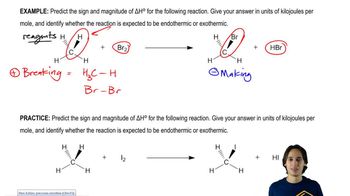
Enthalpy change, denoted as ∆H°, refers to the heat content of a system at constant pressure. It indicates whether a reaction is exothermic (releases heat, ∆H° < 0) or endothermic (absorbs heat, ∆H° > 0). Understanding how to calculate ∆H° is crucial for predicting the energy changes associated with chemical reactions.
Recommended video:
Guided course
04:38
Calculating Enthalpies

Hess's Law

Hess's Law states that the total enthalpy change for a reaction is the sum of the enthalpy changes for each step of the reaction, regardless of the pathway taken. This principle allows chemists to calculate ∆H° for complex reactions by breaking them down into simpler steps for which enthalpy values are known.
Recommended video:
1:39
The Beer-Lambert Law Concept 2

Standard State Conditions

Standard state conditions refer to the specific set of conditions (usually 1 atm pressure and a specified temperature, typically 25°C) under which thermodynamic measurements are made. Understanding these conditions is essential for accurately reporting and comparing enthalpy values, as they provide a consistent reference point for reactions.
Recommended video:
Guided course
03:08
Ground vs. Excited States