Ch. 17 - Reactions of Aromatic Compounds
Wade - Organic Chemistry 9th Edition
Wade9th EditionOrganic ChemistryISBN: 9780135213728Not the one you use?Change textbook
Chapter 17, Problem 42

1,4-Benzoquinone is a good Diels–Alder dienophile. Predict the products of its reaction with
a. buta-1,3-diene
b. cyclopenta-1,3-diene

Verified step by step guidance
1
Identify the components of the Diels–Alder reaction: 1,4-Benzoquinone is the dienophile (electron-deficient alkene), and the diene is either buta-1,3-diene or cyclopenta-1,3-diene. The reaction involves a [4+2] cycloaddition, where the diene contributes 4 π-electrons and the dienophile contributes 2 π-electrons.
Analyze the structure of 1,4-Benzoquinone: It has two conjugated carbonyl groups (C=O) that withdraw electron density from the double bonds, making it highly reactive as a dienophile. The double bonds in 1,4-Benzoquinone will participate in the cycloaddition reaction.
For part (a), align buta-1,3-diene with 1,4-Benzoquinone: Ensure the diene adopts an s-cis conformation (required for the Diels–Alder reaction). The reaction will form a six-membered ring, with the new bonds forming between the terminal carbons of the diene and the carbons of the dienophile's double bond.
For part (b), align cyclopenta-1,3-diene with 1,4-Benzoquinone: Cyclopenta-1,3-diene is already locked in an s-cis conformation, making it highly reactive. The reaction will form a bicyclic product, where the six-membered ring from the Diels–Alder reaction is fused to the five-membered ring of the diene.
Draw the products: For both reactions, the newly formed six-membered ring will contain two carbonyl groups (C=O) from the original 1,4-Benzoquinone. In part (a), the product will be a single six-membered ring, while in part (b), the product will be a bicyclic compound with a fused ring system.

Verified video answer for a similar problem:

This video solution was recommended by our tutors as helpful for the problem above.
Video duration:
9m
Was this helpful?

Key Concepts

Here are the essential concepts you must grasp in order to answer the question correctly.

Diels–Alder Reaction

The Diels–Alder reaction is a [4+2] cycloaddition reaction between a conjugated diene and a dienophile, resulting in the formation of a six-membered ring. This reaction is a key method in organic synthesis for constructing cyclic compounds and is characterized by its stereospecificity and regioselectivity. Understanding the reactivity of the diene and dienophile is crucial for predicting the products.
Recommended video:
Guided course
04:02
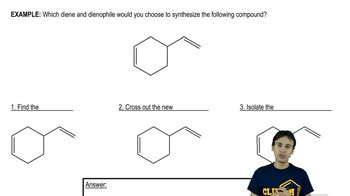
Diels-Alder Retrosynthesis

Dienophile

A dienophile is a compound that reacts with a diene in a Diels–Alder reaction. It typically contains electron-withdrawing groups that enhance its reactivity by stabilizing the transition state. In this case, 1,4-Benzoquinone acts as a strong dienophile due to its electron-deficient nature, making it highly reactive towards electron-rich dienes like buta-1,3-diene and cyclopenta-1,3-diene.
Recommended video:
Guided course
09:48
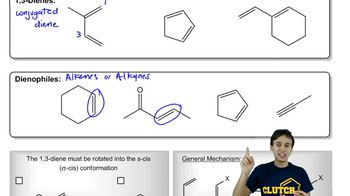
General Features

Regioselectivity

Regioselectivity refers to the preference of a chemical reaction to yield one structural isomer over others when multiple products are possible. In the context of the Diels–Alder reaction, the orientation of the diene and dienophile can lead to different regioisomers. Analyzing the substituents and electronic effects on both reactants helps predict the major product formed in the reaction.
Recommended video:
Guided course
05:09
Heck Reaction