
Ch. 17 - Reactions of Aromatic Compounds
Wade - Organic Chemistry 9th Edition
Wade9th EditionOrganic ChemistryISBN: 9780135213728Not the one you use?Change textbook
Chapter 17, Problem 14b(ii)

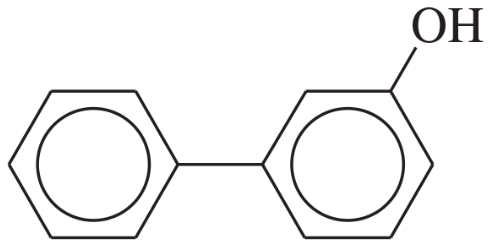
Biphenyl is two benzene rings joined by a single bond. The site of substitution for a biphenyl is determined by (1) which phenyl ring is more activated (or less deactivated), and (2) which position on that ring is most reactive, using the fact that a phenyl substituent is activating and ortho, para-directing.
b. Predict the mononitration products of the following compounds
(ii)

Verified step by step guidance
1
Step 1: Analyze the structure of biphenyl with a hydroxyl (-OH) group attached to one of the benzene rings. The hydroxyl group is an activating group and is ortho, para-directing, meaning it increases the reactivity of the benzene ring it is attached to and directs substitution to the ortho and para positions relative to itself.
Step 2: Determine which phenyl ring is more activated. The phenyl ring with the hydroxyl group is more activated due to the electron-donating nature of the -OH group. The other phenyl ring is less activated because it does not have any substituents.
Step 3: Identify the most reactive positions on the activated phenyl ring. The ortho and para positions relative to the hydroxyl group are the most reactive due to the directing effect of the -OH group.
Step 4: Predict the mononitration product. Nitration involves the introduction of a nitro group (-NO₂) to the benzene ring. The nitro group will preferentially substitute at the ortho or para positions of the phenyl ring with the hydroxyl group.
Step 5: Consider steric hindrance. The para position is less sterically hindered compared to the ortho positions, so the major product of mononitration is likely to have the nitro group at the para position relative to the hydroxyl group. Minor products may include substitution at the ortho positions.

Verified video answer for a similar problem:

This video solution was recommended by our tutors as helpful for the problem above.
Video duration:
2m
Was this helpful?

Key Concepts

Here are the essential concepts you must grasp in order to answer the question correctly.

Electrophilic Aromatic Substitution (EAS)

Electrophilic Aromatic Substitution is a fundamental reaction in organic chemistry where an electrophile replaces a hydrogen atom on an aromatic ring. This process is crucial for understanding how substituents influence the reactivity of aromatic compounds, such as biphenyl. The presence of activating groups can enhance the rate of substitution, while deactivating groups can hinder it.
Recommended video:

Activating and Deactivating Groups

Substituents on an aromatic ring can be classified as activating or deactivating based on their electronic effects. Activating groups, like hydroxyl (-OH), increase the electron density of the ring, making it more reactive towards electrophiles. Conversely, deactivating groups withdraw electron density, reducing reactivity. Understanding these effects is essential for predicting the outcomes of substitution reactions.
Recommended video:
Guided course
03:27
Activating and deactivating groups

Ortho/Para-Directing Effects

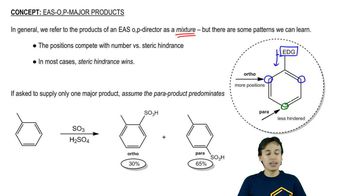
In electrophilic aromatic substitution, substituents can direct incoming electrophiles to specific positions on the aromatic ring. Ortho and para directing groups favor substitution at the 2 and 4 positions relative to themselves. This directing effect is significant when predicting the products of reactions involving biphenyl, especially when one ring has an activating substituent like -OH.
Recommended video:
Guided course
04:42
Ortho, Para major products
Related Practice
Textbook Question

Biphenyl is two benzene rings joined by a single bond. The site of substitution for a biphenyl is determined by (1) which phenyl ring is more activated (or less deactivated), and (2) which position on that ring is most reactive, using the fact that a phenyl substituent is activating and ortho, para-directing.

b. Predict the mononitration products of the following compounds

(iv)

1557
views
Textbook Question

Biphenyl is two benzene rings joined by a single bond. The site of substitution for a biphenyl is determined by (1) which phenyl ring is more activated (or less deactivated), and (2) which position on that ring is most reactive, using the fact that a phenyl substituent is activating and ortho, para-directing.

b. Predict the mononitration products of the following compounds

(vi)

2508
views
1
rank
Textbook Question

Biphenyl is two benzene rings joined by a single bond. The site of substitution for a biphenyl is determined by (1) which phenyl ring is more activated (or less deactivated), and (2) which position on that ring is most reactive, using the fact that a phenyl substituent is activating and ortho, para-directing.

b. Predict the mononitration products of the following compounds

(v)

1376
views
Textbook Question

Biphenyl is two benzene rings joined by a single bond. The site of substitution for a biphenyl is determined by (1) which phenyl ring is more activated (or less deactivated), and (2) which position on that ring is most reactive, using the fact that a phenyl substituent is activating and ortho, para-directing.

b. Predict the mononitration products of the following compounds

(i)

687
views
Textbook Question

Biphenyl is two benzene rings joined by a single bond. The site of substitution for a biphenyl is determined by (1) which phenyl ring is more activated (or less deactivated), and (2) which position on that ring is most reactive, using the fact that a phenyl substituent is activating and ortho, para-directing.

a. Use resonance forms of a sigma complex to show why a phenyl substituent should be ortho, para-directing.

(vi)

640
views
Textbook Question

Biphenyl is two benzene rings joined by a single bond. The site of substitution for a biphenyl is determined by (1) which phenyl ring is more activated (or less deactivated), and (2) which position on that ring is most reactive, using the fact that a phenyl substituent is activating and ortho, para-directing.

b. Predict the mononitration products of the following compounds

(iii)

674
views