Ch. 17 - Reactions of Aromatic Compounds
Wade - Organic Chemistry 9th Edition
Wade9th EditionOrganic ChemistryISBN: 9780135213728Not the one you use?Change textbook
Chapter 17, Problem 50f

Predict the major products formed when benzene reacts (just once) with the following reagents.
f. fuming sulfuric acid

Verified step by step guidance
1
Step 1: Recognize the reaction type. Benzene reacts with fuming sulfuric acid in an electrophilic aromatic substitution reaction, specifically sulfonation. Fuming sulfuric acid contains sulfur trioxide (SO₃) dissolved in concentrated sulfuric acid, which acts as the electrophile.
Step 2: Identify the electrophile. In this reaction, the electrophile is sulfur trioxide (SO₃), which reacts with benzene to form a sulfonic acid group (-SO₃H) attached to the benzene ring.
Step 3: Determine the mechanism. The reaction proceeds via the formation of a sigma complex (arenium ion) when the benzene ring donates π-electrons to the electrophile. This intermediate is stabilized by resonance.
Step 4: Regenerate aromaticity. The loss of a proton from the sigma complex restores the aromaticity of the benzene ring, resulting in the formation of benzene sulfonic acid.
Step 5: Predict the major product. Since the reaction occurs just once, the major product is benzene with a single sulfonic acid group (-SO₃H) attached to the ring. The position of substitution is typically at one of the carbons on the benzene ring, forming benzene sulfonic acid.

Verified video answer for a similar problem:

This video solution was recommended by our tutors as helpful for the problem above.
Video duration:
4m
Was this helpful?

Key Concepts

Here are the essential concepts you must grasp in order to answer the question correctly.

Electrophilic Aromatic Substitution

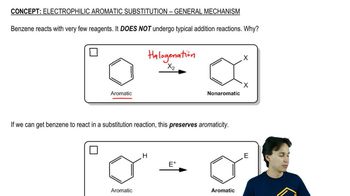
Electrophilic aromatic substitution (EAS) is a fundamental reaction in organic chemistry where an electrophile replaces a hydrogen atom on an aromatic ring. In the case of benzene reacting with fuming sulfuric acid, the sulfur trioxide (SO3) generated acts as a strong electrophile, leading to the substitution of a hydrogen atom on the benzene ring.
Recommended video:

Sulfonation of Benzene

The sulfonation of benzene involves the introduction of a sulfonyl group (–SO3H) into the aromatic ring. When benzene reacts with fuming sulfuric acid, the major product formed is benzene sulfonic acid, which is a result of the electrophilic attack by the sulfur trioxide generated in the reaction. This process is reversible and can be reversed by hydrolysis.
Recommended video:
Guided course
09:04
Benzene Nomenclature

Reaction Conditions and Mechanism

The reaction conditions, such as the presence of fuming sulfuric acid, significantly influence the mechanism and outcome of the reaction. Fuming sulfuric acid provides a concentrated source of sulfur trioxide, enhancing the electrophilic character and facilitating the sulfonation process. Understanding the mechanism helps predict the major product and the conditions under which the reaction occurs.
Recommended video:
Guided course
02:16
Heck Reaction Mechanism