Ch. 17 - Reactions of Aromatic Compounds
Wade - Organic Chemistry 9th Edition
Wade9th EditionOrganic ChemistryISBN: 9780135213728Not the one you use?Change textbook
Chapter 17, Problem 53a

Predict the major products of the following reactions.
(a) 2,4-dinitrochlorobenzene + NaOCH3

Verified step by step guidance
1
Step 1: Analyze the reactants. The starting material is 2,4-dinitrochlorobenzene, which contains two electron-withdrawing nitro groups (-NO2) at the 2 and 4 positions and a chlorine atom (-Cl) at the 1 position. The reagent is sodium methoxide (NaOCH3), a strong nucleophile and base.
Step 2: Understand the reaction mechanism. This reaction proceeds via nucleophilic aromatic substitution (SNAr). The electron-withdrawing nitro groups activate the aromatic ring by stabilizing the negative charge formed during the intermediate step, making the chlorine atom susceptible to nucleophilic attack.
Step 3: Predict the site of substitution. The chlorine atom is the leaving group, and the methoxide ion (CH3O-) will replace it. The nitro groups at the 2 and 4 positions enhance the reactivity of the ring by withdrawing electron density, facilitating the substitution reaction.
Step 4: Draw the product structure. After substitution, the chlorine atom is replaced by the methoxy group (-OCH3), resulting in 2,4-dinitroanisole. The nitro groups remain intact at the 2 and 4 positions, and the methoxy group is attached to the 1 position.
Step 5: Verify the major product. The major product is 2,4-dinitroanisole, as the reaction is regioselective due to the activating effect of the nitro groups. This matches the expected outcome of the nucleophilic aromatic substitution mechanism.

Verified video answer for a similar problem:

This video solution was recommended by our tutors as helpful for the problem above.
Video duration:
7m
Was this helpful?

Key Concepts

Here are the essential concepts you must grasp in order to answer the question correctly.

Electrophilic Aromatic Substitution (EAS)

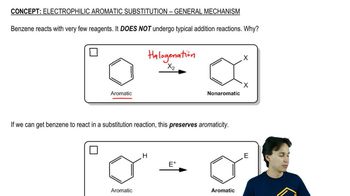
Electrophilic Aromatic Substitution is a fundamental reaction in organic chemistry where an electrophile replaces a hydrogen atom on an aromatic ring. The reaction typically involves the formation of a sigma complex, where the aromaticity is temporarily lost, followed by deprotonation to restore aromaticity. Understanding the nature of the electrophile and the substituents on the aromatic ring is crucial for predicting the major products.
Recommended video:

Activating and Deactivating Groups

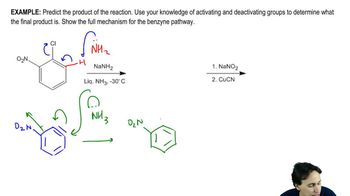
Substituents on an aromatic ring can either activate or deactivate the ring towards electrophilic substitution. Activating groups, such as -OCH3, increase the electron density of the ring, making it more reactive, while deactivating groups, like -NO2, withdraw electron density and make the ring less reactive. The position of these groups (ortho, meta, para) also influences the regioselectivity of the substitution reaction.
Recommended video:
Guided course
03:27
Activating and deactivating groups

Regioselectivity in EAS Reactions

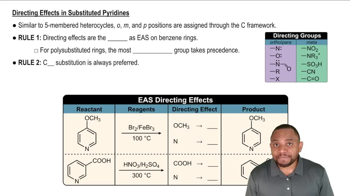
Regioselectivity refers to the preference of an electrophilic substitution reaction to occur at a specific position on the aromatic ring. The presence of substituents can direct incoming electrophiles to ortho, meta, or para positions based on their electronic effects. For example, activating groups typically direct substitution to the ortho and para positions, while deactivating groups often direct it to the meta position.
Recommended video:
3:22
EAS Reactions of Pyridine Concept 3