
Ch. 17 - Reactions of Aromatic Compounds
Wade - Organic Chemistry 9th Edition
Wade9th EditionOrganic ChemistryISBN: 9780135213728Not the one you use?Change textbook
Chapter 17, Problem 12f

Predict the mononitration products of the following compounds.
f. o-hydroxyacetophenone

Verified step by step guidance
1
Identify the functional groups present in o-hydroxyacetophenone. The molecule contains a hydroxyl (-OH) group and a ketone group (-COCH3) attached to a benzene ring. The hydroxyl group is ortho to the ketone group.
Understand the directing effects of the substituents. The hydroxyl group (-OH) is an activating, ortho/para-directing group due to its electron-donating nature through resonance and induction. The ketone group (-COCH3) is a deactivating, meta-directing group due to its electron-withdrawing nature.
Determine the major directing group. Since the hydroxyl group is more activating than the ketone group, it will dominate the directing effects during the nitration reaction.
Predict the nitration reaction. In the presence of a nitrating mixture (HNO₃ and H₂SO₄), the nitro group (-NO₂) will preferentially add to the positions ortho and para to the hydroxyl group. However, the ortho position relative to the hydroxyl group is already occupied by the ketone group, so the nitro group will primarily add to the para position relative to the hydroxyl group.
Draw the product structure. The major mononitration product will have the nitro group (-NO₂) at the para position relative to the hydroxyl group, while the ketone group remains at the ortho position relative to the hydroxyl group.

Verified video answer for a similar problem:

This video solution was recommended by our tutors as helpful for the problem above.
Video duration:
3m
Was this helpful?

Key Concepts

Here are the essential concepts you must grasp in order to answer the question correctly.

Electrophilic Aromatic Substitution

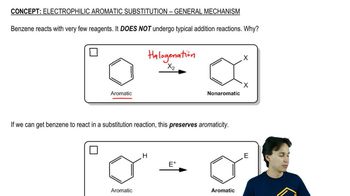
Electrophilic aromatic substitution (EAS) is a fundamental reaction in organic chemistry where an electrophile replaces a hydrogen atom on an aromatic ring. This process is crucial for understanding how substituents on the ring influence the reactivity and orientation of further substitutions, such as nitration. The presence of electron-donating or electron-withdrawing groups can significantly affect the position where the electrophile attacks.
Recommended video:

Activating and Deactivating Groups

In the context of EAS, substituents on the aromatic ring can be classified as activating or deactivating groups. Activating groups, like -OH in o-hydroxyacetophenone, increase the electron density of the ring, making it more reactive towards electrophiles. Conversely, deactivating groups withdraw electron density, making the ring less reactive. The nature of these groups determines the regioselectivity of the nitration reaction.
Recommended video:
Guided course
03:27
Activating and deactivating groups

Regioselectivity in Nitration

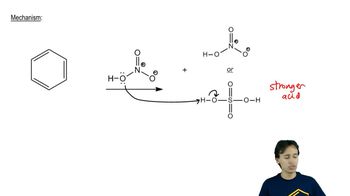
Regioselectivity refers to the preference of a chemical reaction to occur at one location over another in a molecule. In the case of o-hydroxyacetophenone, the hydroxyl group (-OH) is an ortho/para director, meaning that nitration will preferentially occur at the ortho or para positions relative to the -OH group. Understanding this concept is essential for predicting the specific nitration products formed in the reaction.
Recommended video:
Guided course
06:09
EAS Nitration
Related Practice
Textbook Question

Biphenyl is two benzene rings joined by a single bond. The site of substitution for a biphenyl is determined by (1) which phenyl ring is more activated (or less deactivated), and (2) which position on that ring is most reactive, using the fact that a phenyl substituent is activating and ortho, para-directing.

b. Predict the mononitration products of the following compounds

(vi)

2508
views
1
rank
Textbook Question

Predict the mononitration products of the following compounds.

d. p-methoxybenzoic acid

881
views
Textbook Question

In an aqueous solution containing sodium bicarbonate, aniline reacts quickly with bromine to give 2,4,6-tribromoaniline. Nitration of aniline requires very strong conditions, however, and the yields (mostly m-nitroaniline) are poor.

c. Although nitration of aniline is slow and gives mostly meta substitution, nitration of acetanilide (PhNHCOCH3) goes quickly and gives mostly para substitution. Use resonance forms to explain this difference in reactivity.

931
views
Textbook Question

Biphenyl is two benzene rings joined by a single bond. The site of substitution for a biphenyl is determined by (1) which phenyl ring is more activated (or less deactivated), and (2) which position on that ring is most reactive, using the fact that a phenyl substituent is activating and ortho, para-directing.

a. Use resonance forms of a sigma complex to show why a phenyl substituent should be ortho, para-directing.

(vi)

640
views
Textbook Question

Biphenyl is two benzene rings joined by a single bond. The site of substitution for a biphenyl is determined by (1) which phenyl ring is more activated (or less deactivated), and (2) which position on that ring is most reactive, using the fact that a phenyl substituent is activating and ortho, para-directing.

a. Use resonance forms of a sigma complex to show why a phenyl substituent should be ortho, para-directing.

(i)

3946
views
Textbook Question

Predict the mononitration products of the following compounds.

a. o-nitrotoluene

b. m-chlorotoluene

c. o-bromobenzoic acid

1971
views
1
rank