
Ch. 17 - Reactions of Aromatic Compounds
Wade - Organic Chemistry 9th Edition
Wade9th EditionOrganic ChemistryISBN: 9780135213728Not the one you use?Change textbook
Chapter 17, Problem 72

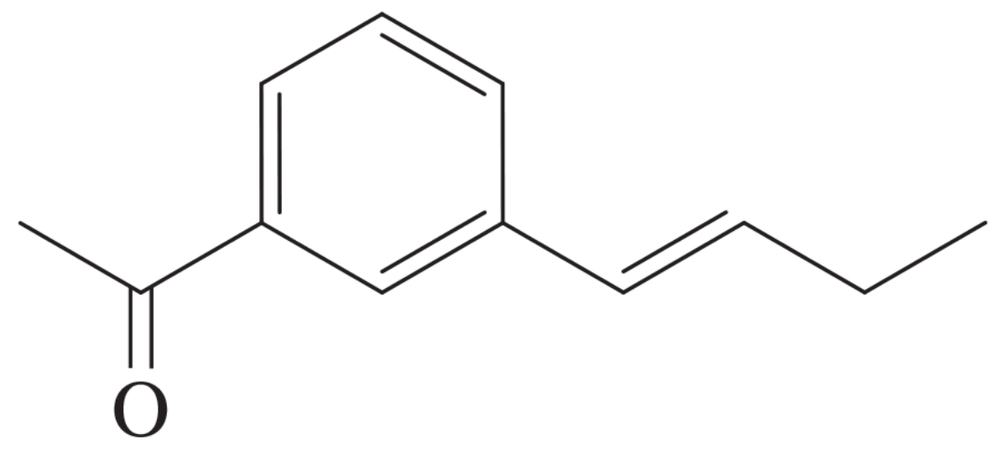
Starting with benzene and any other reagents you need, show how you would synthesize the compound shown here. (Hint: Consider a Pd-catalyzed coupling for the final step.)

Verified step by step guidance
1
Step 1: Begin with benzene as the starting material. Perform a Friedel-Crafts alkylation using isopropyl chloride (CH3CHClCH3) and AlCl3 as the catalyst to introduce the isopropyl group onto the benzene ring, forming isopropylbenzene.
Step 2: Brominate the isopropylbenzene by reacting it with Br2 and FeBr3 as the catalyst. This will selectively add a bromine atom to the benzene ring in the para position relative to the isopropyl group, forming para-bromo-isopropylbenzene.
Step 3: Prepare the alkenyl coupling partner by synthesizing 1-butenylboronic acid. This can be achieved by hydroboration of 1-butyne using a borane reagent, followed by oxidation to form the boronic acid.
Step 4: Perform a Suzuki coupling reaction using para-bromo-isopropylbenzene and 1-butenylboronic acid. Use a palladium catalyst (e.g., Pd(PPh3)4) and a base such as K2CO3 in an appropriate solvent like toluene or ethanol to couple the two components, forming the desired product.
Step 5: Purify the final product using techniques such as recrystallization or column chromatography to isolate the compound shown in the image.

Verified video answer for a similar problem:

This video solution was recommended by our tutors as helpful for the problem above.
Video duration:
12m
Was this helpful?

Key Concepts

Here are the essential concepts you must grasp in order to answer the question correctly.

Electrophilic Aromatic Substitution (EAS)

EAS is a fundamental reaction in organic chemistry where an electrophile replaces a hydrogen atom on an aromatic ring. This process is crucial for modifying benzene derivatives to create more complex structures. Understanding the mechanism, which involves the formation of a sigma complex and subsequent deprotonation, is essential for synthesizing compounds from benzene.

Palladium-Catalyzed Coupling Reactions

Palladium-catalyzed coupling reactions, such as Suzuki or Heck reactions, are powerful methods for forming carbon-carbon bonds. These reactions typically involve the coupling of an aryl halide with an organometallic reagent in the presence of a palladium catalyst. This concept is particularly relevant for the final step of the synthesis, as it allows for the introduction of substituents onto the aromatic ring.

Reagents and Reaction Conditions

The choice of reagents and reaction conditions is critical in organic synthesis. For the synthesis of the target compound, one must consider the appropriate electrophiles, bases, and solvents that facilitate the desired reactions. Additionally, understanding the role of temperature and pressure can influence reaction rates and yields, making it essential to optimize these parameters for successful synthesis.
Related Practice
Textbook Question

In Chapter 14, we saw that Agent Orange contains (2,4,5-trichlorophenoxy) acetic acid, called 2,4,5-T. This compound is synthesized by the partial reaction of 1,2,4,5-tetrachlorobenzene with sodium hydroxide, followed by reaction with sodium chloroacetate, ClCH2CO2Na.

a. Draw the structures of these compounds, and write equations for these reactions.

776
views
Textbook Question

Show how you would use a Suzuki reaction to synthesize the following biaryl compound. As starting materials, you may use the two indicated compounds, plus any additional reagents you need.

1378
views
Textbook Question

Phenol reacts with three equivalents of bromine in CCl4 (in the dark) to give a product of formula C6H3OBr3. When this product is added to bromine water, a yellow solid of molecular formula C6H2OBr4 precipitates out of the solution. The IR spectrum of the yellow precipitate shows a strong absorption (much like that of a quinone) around 1680 cm–1. Propose structures for the two products.

4536
views
Textbook Question

The antioxidants BHA and BHT are commonly used as food preservatives. Show how BHA and BHT can be made from phenol and hydroquinone

2179
views
Textbook Question

A common illicit synthesis of methamphetamine involves an interesting variation of the Birch reduction. A solution of ephedrine in alcohol is added to liquid ammonia, followed by several pieces of lithium metal. The Birch reduction usually reduces the aromatic ring (Section 17-14C), but in this case it eliminates the hydroxy group of ephedrine to give methamphetamine. Propose a mechanism, similar to that for the Birch reduction, to explain this unusual course of the reaction.

1225
views
Textbook Question

Unlike most other electrophilic aromatic substitutions, sulfonation is often reversible (see Section 17-4). When one sample of toluene is sulfonated at 0 °C and another sample is sulfonated at 100 °C, the following ratios of substitution products result:

c. Because the SO3H group can be added to a benzene ring and removed later, it is sometimes called a blocking group. Show how 2,6-dibromotoluene can be made from toluene using sulfonation and desulfonation as intermediate steps in the synthesis.

1265
views