Ch. 18 - Ketones and Aldehydes
Wade - Organic Chemistry 9th Edition
Wade9th EditionOrganic ChemistryISBN: 9780135213728Not the one you use?Change textbook
Chapter 18, Problem 4d(3,4)

Give the structure of the principal product(s) when each of the following alcohols reacts with (3) DMP and (4) 1 equiv NaOCl-TEMPO.
d. 1-methylcyclohexan-1,4-diol

Verified step by step guidance
1
Step 1: Understand the reagents involved in the reaction. DMP (Dess-Martin Periodinane) is a mild oxidizing agent that selectively oxidizes primary alcohols to aldehydes and secondary alcohols to ketones. NaOCl-TEMPO is another oxidizing system that can oxidize alcohols, typically primary alcohols to aldehydes and secondary alcohols to ketones.
Step 2: Analyze the structure of the given alcohol, 1-methylcyclohexan-1,4-diol. This molecule contains two hydroxyl (-OH) groups: one at the 1-position (attached to a tertiary carbon) and another at the 4-position (attached to a secondary carbon). The tertiary alcohol at the 1-position is resistant to oxidation under these conditions, while the secondary alcohol at the 4-position is susceptible to oxidation.
Step 3: Predict the reaction with DMP. DMP will oxidize the secondary alcohol at the 4-position to a ketone, leaving the tertiary alcohol at the 1-position unchanged. The resulting product will be 1-methylcyclohexan-1-4-one.
Step 4: Predict the reaction with NaOCl-TEMPO. Similar to DMP, NaOCl-TEMPO will oxidize the secondary alcohol at the 4-position to a ketone, leaving the tertiary alcohol at the 1-position unchanged. The resulting product will again be 1-methylcyclohexan-1-4-one.
Step 5: Summarize the principal product(s). In both cases (reaction with DMP and NaOCl-TEMPO), the principal product is the same: 1-methylcyclohexan-1-4-one. This is due to the selective oxidation of the secondary alcohol at the 4-position while the tertiary alcohol at the 1-position remains unaffected.

Verified video answer for a similar problem:

This video solution was recommended by our tutors as helpful for the problem above.
Video duration:
4m
Was this helpful?

Key Concepts

Here are the essential concepts you must grasp in order to answer the question correctly.

Oxidation of Alcohols

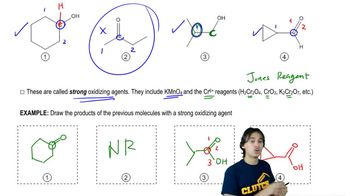
Alcohols can undergo oxidation to form carbonyl compounds, such as aldehydes or ketones. The extent of oxidation depends on the reagents used; for instance, DMP (Dess-Martin periodinane) is a mild oxidizing agent that selectively converts primary and secondary alcohols to aldehydes and ketones, respectively, without over-oxidizing them to carboxylic acids.
Recommended video:
Guided course
05:53
Strong oxidizing agents

DMP as an Oxidizing Agent

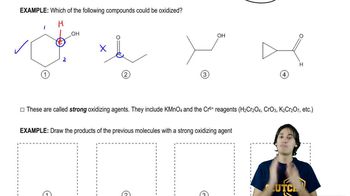
Dess-Martin periodinane (DMP) is a popular reagent in organic chemistry for the oxidation of alcohols. It is favored for its ability to oxidize alcohols to carbonyls under mild conditions, minimizing side reactions. Understanding how DMP interacts with different alcohols is crucial for predicting the structure of the resulting products.
Recommended video:
Guided course
03:40
Strong oxidizing agents

NaOCl-TEMPO Oxidation

The combination of sodium hypochlorite (NaOCl) and TEMPO (2,2,6,6-tetramethylpiperidine-1-oxyl) is used for the selective oxidation of alcohols to carbonyl compounds. This method is particularly useful for secondary alcohols and can provide high yields of ketones. Recognizing the reactivity of the alcohol in question with this reagent is essential for determining the principal product.
Recommended video:
Guided course
03:20
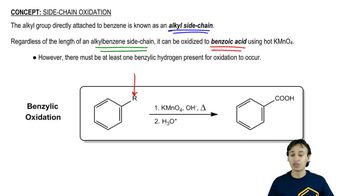
Benzylic Oxidation