Ch. 18 - Ketones and Aldehydes
Wade - Organic Chemistry 9th Edition
Wade9th EditionOrganic ChemistryISBN: 9780135213728Not the one you use?Change textbook
Chapter 18, Problem 38k

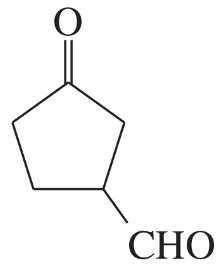
Name the following ketones and aldehydes. When possible, give both a common name and an IUPAC name.
(k)

Verified step by step guidance
1
Step 1: Identify the functional groups in the molecule. The structure contains both a ketone group (C=O) and an aldehyde group (-CHO).
Step 2: Determine the parent chain or ring. The molecule is a cyclopentane ring with substituents attached.
Step 3: Assign priority to the functional groups. According to IUPAC nomenclature rules, the aldehyde group (-CHO) takes precedence over the ketone group (C=O) when naming the compound.
Step 4: Number the ring starting from the carbon attached to the aldehyde group (-CHO) as position 1, and proceed in the direction that gives the ketone group the lowest possible number.
Step 5: Combine the names of the functional groups and the parent chain. The IUPAC name will reflect the aldehyde and ketone positions, while the common name may use traditional naming conventions for cyclic compounds with these functional groups.

Verified video answer for a similar problem:

This video solution was recommended by our tutors as helpful for the problem above.
Video duration:
5m
Was this helpful?

Key Concepts

Here are the essential concepts you must grasp in order to answer the question correctly.

Functional Groups

Functional groups are specific groups of atoms within molecules that are responsible for the characteristic chemical reactions of those molecules. In the case of ketones and aldehydes, the carbonyl group (C=O) is the key functional group. Aldehydes have the carbonyl group at the end of the carbon chain, while ketones have it within the chain.
Recommended video:
Guided course
02:36
Identifying Functional Groups

IUPAC Nomenclature

IUPAC nomenclature is a systematic method of naming organic chemical compounds. It provides a unique name for each compound based on its structure, which includes identifying the longest carbon chain, the position of functional groups, and the type of functional group present. For ketones and aldehydes, the suffixes '-one' and '-al' are used, respectively.
Recommended video:
Guided course
03:43
The different parts of an IUPAC name

Common Names vs. IUPAC Names

Common names are traditional names that may not follow systematic rules, while IUPAC names are standardized and provide clear information about the structure of the compound. For example, the common name for acetaldehyde is derived from its use in the production of acetic acid, while its IUPAC name reflects its structure as ethanal. Understanding both naming conventions is essential for accurately identifying organic compounds.
Recommended video:
Guided course
03:43
The different parts of an IUPAC name