Ch. 18 - Ketones and Aldehydes
Wade - Organic Chemistry 9th Edition
Wade9th EditionOrganic ChemistryISBN: 9780135213728Not the one you use?Change textbook
Chapter 18, Problem 36d

Predict the major products of the following reactions:
(d) Chemical structure of an acetal with reaction conditions: Zn(Hg) in HCl and water for nucleophilic addition.

Verified step by step guidance
1
Step 1: Recognize the reaction type. The reagents Zn(Hg), HCl, and H2O indicate a Clemmensen reduction, which is used to reduce ketones or aldehydes to their corresponding alkanes.
Step 2: Identify the functional group being reduced. In the given molecule, the ketone group (C=O) is the functional group that will be reduced to a methylene group (-CH2).
Step 3: Analyze the rest of the molecule. The cyclic structure with the acetal group (two oxygen atoms connected to the same carbon) is stable under the acidic conditions of the Clemmensen reduction and will remain unchanged.
Step 4: Predict the major product. The ketone group will be reduced to a methylene group, while the acetal group and the cyclic structure will stay intact.
Step 5: Draw the structure of the major product. Replace the ketone group with a methylene group (-CH2) and keep the rest of the molecule unchanged.

Verified video answer for a similar problem:

This video solution was recommended by our tutors as helpful for the problem above.
Video duration:
2m
Was this helpful?

Key Concepts

Here are the essential concepts you must grasp in order to answer the question correctly.

Reaction Mechanisms

Understanding reaction mechanisms is crucial in organic chemistry as they describe the step-by-step process by which reactants transform into products. This includes identifying intermediates, transition states, and the movement of electrons. Familiarity with mechanisms helps predict the major products of a reaction based on the stability of intermediates and the energy changes involved.
Recommended video:
Guided course
02:16
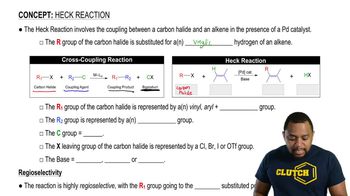
Heck Reaction Mechanism

Functional Groups

Functional groups are specific groups of atoms within molecules that are responsible for the characteristic chemical reactions of those molecules. Recognizing functional groups in the reactants allows chemists to anticipate how they will interact during a reaction. This knowledge is essential for predicting the products formed, as different functional groups can lead to distinct reaction pathways.
Recommended video:
Guided course
02:36
Identifying Functional Groups

Regioselectivity and Stereoselectivity

Regioselectivity refers to the preference of a chemical reaction to yield one structural isomer over others, while stereoselectivity involves the preference for a specific stereoisomer. These concepts are important when predicting products, as they determine which atoms or bonds are involved in the reaction and how the spatial arrangement of atoms affects the final product. Understanding these principles helps in accurately forecasting the outcome of organic reactions.
Recommended video:
Guided course
05:09
Heck Reaction