

Ch. 18 - Ketones and Aldehydes
Wade - Organic Chemistry 9th Edition
Wade9th EditionOrganic ChemistryISBN: 9780135213728Not the one you use?Change textbook
Chapter 18, Problem 40

Rank the following carbonyl compounds in order of increasing equilibrium constant for hydration:
CH3COCH2Cl ClCH2CHO CH2O CH3COCH3 CH3CHO

Verified step by step guidance
1
Step 1: Understand the hydration equilibrium constant. The equilibrium constant for hydration of carbonyl compounds depends on the electrophilicity of the carbonyl carbon. Electrophilicity is influenced by the substituents attached to the carbonyl group and their ability to stabilize or destabilize the partial positive charge on the carbonyl carbon.
Step 2: Analyze the substituents on each compound. Electron-withdrawing groups (like Cl) increase the electrophilicity of the carbonyl carbon, making hydration more favorable. Conversely, electron-donating groups (like alkyl groups) decrease electrophilicity, making hydration less favorable.
Step 3: Rank the compounds based on substituents: - CH2O (formaldehyde) has no substituents, making its carbonyl carbon highly electrophilic. - ClCH2CHO has one electron-withdrawing chlorine atom, increasing electrophilicity. - CH3CHO (acetaldehyde) has one electron-donating methyl group, decreasing electrophilicity. - CH3COCH2Cl has a chlorine atom further away from the carbonyl group, reducing its effect compared to ClCH2CHO. - CH3COCH3 (acetone) has two electron-donating methyl groups, making its carbonyl carbon the least electrophilic.
Step 4: Consider steric effects. Steric hindrance can also affect hydration. Smaller molecules like CH2O and ClCH2CHO are less sterically hindered, making hydration easier compared to larger molecules like CH3COCH3.
Step 5: Final ranking based on increasing equilibrium constant for hydration: CH3COCH3 < CH3COCH2Cl < CH3CHO < ClCH2CHO < CH2O.

Verified video answer for a similar problem:

This video solution was recommended by our tutors as helpful for the problem above.
Video duration:
6m
Was this helpful?

Key Concepts

Here are the essential concepts you must grasp in order to answer the question correctly.

Carbonyl Compounds

Carbonyl compounds contain a carbon atom double-bonded to an oxygen atom (C=O). This functional group is characteristic of aldehydes, ketones, and carboxylic acids. The reactivity and properties of these compounds are influenced by the nature of the substituents attached to the carbonyl carbon, which can affect their equilibrium constants in hydration reactions.
Recommended video:
Guided course
01:40
Defining meso compounds.

Hydration Equilibrium

Hydration equilibrium refers to the balance between the carbonyl compound and its hydrated form, typically a geminal diol. The equilibrium constant (K) for this reaction indicates the extent to which the carbonyl compound can be converted to its hydrated form. Factors such as steric hindrance and electronic effects from substituents influence the position of this equilibrium.
Recommended video:
Guided course
09:11
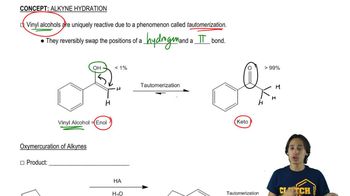
Alkyne Hydration

Electronic and Steric Effects

Electronic effects arise from the electronegativity of substituents, which can stabilize or destabilize the carbonyl group, affecting its reactivity. Steric effects involve the spatial arrangement of atoms around the carbonyl, where bulky groups can hinder the approach of water molecules, thus impacting the hydration equilibrium. Understanding these effects is crucial for predicting the order of equilibrium constants for the given carbonyl compounds.
Recommended video:
Guided course
02:53
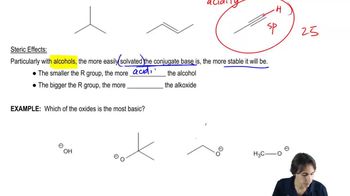
Understanding steric effects.