Ch. 18 - Ketones and Aldehydes
Wade - Organic Chemistry 9th Edition
Wade9th EditionOrganic ChemistryISBN: 9780135213728Not the one you use?Change textbook
Chapter 18, Problem 16b

Show how you would accomplish the following syntheses.
b. cyclopentanecarbaldehyde → 2-cyclopentyl-2-hydroxyacetic acid

Verified step by step guidance
1
Step 1: Begin by identifying the functional groups in the starting material (cyclopentanecarbaldehyde) and the target molecule (2-cyclopentyl-2-hydroxyacetic acid). Cyclopentanecarbaldehyde contains an aldehyde group (-CHO), while the target molecule contains a hydroxyl group (-OH) and a carboxylic acid group (-COOH) attached to the same carbon.
Step 2: Plan the transformation of the aldehyde group into a carboxylic acid group. This can be achieved through oxidation. Use an oxidizing agent such as potassium permanganate (KMnO₄) or chromium-based reagents like Jones reagent (CrO₃/H₂SO₄) to convert the aldehyde (-CHO) to a carboxylic acid (-COOH).
Step 3: Introduce the hydroxyl group (-OH) at the alpha-carbon of the carboxylic acid. This can be accomplished through an aldol reaction or a hydroxylation step. For example, you can use a base like NaOH to generate an enolate intermediate, followed by reaction with an appropriate electrophile to add the hydroxyl group.
Step 4: Ensure stereochemistry is correct for the hydroxyl group addition. If stereoselectivity is required, consider using reagents or conditions that favor the desired stereochemical outcome, such as chiral catalysts or specific reaction temperatures.
Step 5: Purify the product (2-cyclopentyl-2-hydroxyacetic acid) using techniques like recrystallization or chromatography to ensure the final compound is free of impurities and matches the desired structure.

Verified video answer for a similar problem:

This video solution was recommended by our tutors as helpful for the problem above.
Video duration:
6m
Was this helpful?

Key Concepts

Here are the essential concepts you must grasp in order to answer the question correctly.

Functional Groups

Functional groups are specific groups of atoms within molecules that are responsible for the characteristic chemical reactions of those molecules. In this synthesis, understanding the aldehyde functional group in cyclopentanecarbaldehyde and the carboxylic acid group in 2-cyclopentyl-2-hydroxyacetic acid is crucial, as these groups dictate the reactivity and transformation pathways during the synthesis.
Recommended video:
Guided course
02:36
Identifying Functional Groups

Nucleophilic Addition Reactions

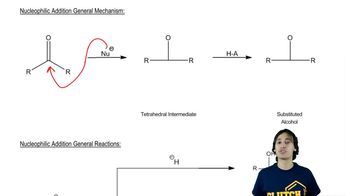
Nucleophilic addition reactions involve the attack of a nucleophile on an electrophilic carbon atom, typically found in carbonyl compounds like aldehydes. In this synthesis, the nucleophilic attack of a hydroxyl group on the carbonyl carbon of cyclopentanecarbaldehyde is a key step in forming the desired hydroxy acid product, highlighting the importance of understanding reaction mechanisms.
Recommended video:
Guided course
08:27
Nucleophilic Addition

Stereochemistry

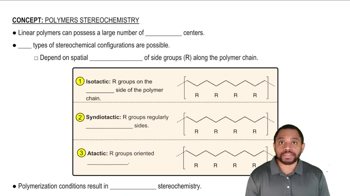
Stereochemistry is the study of the spatial arrangement of atoms in molecules and how this affects their chemical behavior. In the synthesis of 2-cyclopentyl-2-hydroxyacetic acid, recognizing the stereochemical implications of the hydroxyl group addition is essential, as it can lead to different isomers that may have distinct properties and reactivities.
Recommended video:
1:38
Polymer Stereochemistry Concept 1