Ch. 18 - Ketones and Aldehydes
Wade - Organic Chemistry 9th Edition
Wade9th EditionOrganic ChemistryISBN: 9780135213728Not the one you use?Change textbook
Chapter 18, Problem 47d

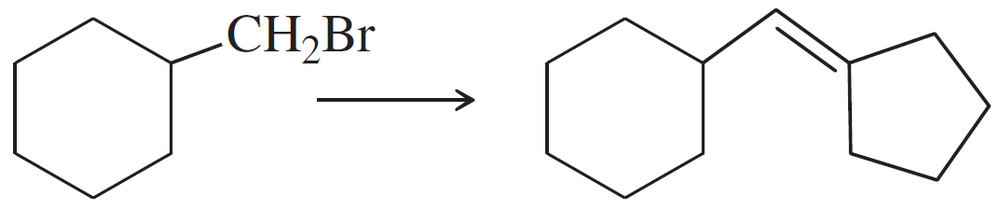
Show how you would accomplish the following synthetic conversions efficiently and in good yield. You may use any necessary additional reagents and solvents.
(d)

Verified step by step guidance
1
Analyze the starting material: The molecule contains a cyclohexane ring with a bromine atom attached to a secondary carbon. This suggests that the bromine can act as a leaving group in a substitution or elimination reaction.
Identify the target molecule: The product is a cyclohexane ring with an alkene (double bond) and an isopropyl group attached to the same carbon. This indicates that the reaction involves elimination followed by alkylation.
Step 1: Perform an elimination reaction to form the double bond. Use a strong base, such as potassium tert-butoxide (KOtBu), to abstract a proton from the β-carbon relative to the bromine. This will result in the formation of the alkene via an E2 mechanism.
Step 2: Alkylate the alkene with isopropyl bromide (CH3CHBrCH3) in the presence of a strong base or an organometallic reagent, such as sodium hydride (NaH) or a Grignard reagent. This will add the isopropyl group to the double bond.
Step 3: Purify the product using standard organic chemistry techniques, such as distillation or chromatography, to ensure a good yield and remove any side products or unreacted reagents.

Verified video answer for a similar problem:

This video solution was recommended by our tutors as helpful for the problem above.
Video duration:
9m
Was this helpful?

Key Concepts

Here are the essential concepts you must grasp in order to answer the question correctly.

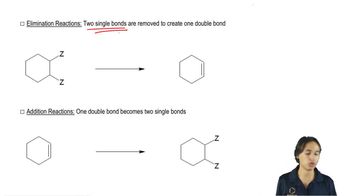
Elimination Reactions

Elimination reactions involve the removal of atoms or groups from a molecule, resulting in the formation of a double bond. In this case, the conversion of bromocyclohexane to cyclohexene is a classic example of an elimination reaction, specifically an E2 mechanism, where a base abstracts a proton while the leaving group (bromine) departs, leading to the formation of an alkene.
Recommended video:
Guided course
00:40
Recognizing Elimination Reactions.

Reagents and Conditions

The choice of reagents and reaction conditions is crucial for achieving high yields in synthetic conversions. For the elimination of bromocyclohexane, a strong base such as potassium tert-butoxide or sodium ethoxide is often used, along with appropriate solvents like ethanol or dimethyl sulfoxide (DMSO) to facilitate the reaction and stabilize the transition state.
Recommended video:

Regioselectivity and Stereochemistry

Regioselectivity refers to the preference of a chemical reaction to yield one structural isomer over others, while stereochemistry deals with the spatial arrangement of atoms in molecules. In the conversion of bromocyclohexane to cyclohexene, understanding the regioselectivity helps predict the major product, and considering stereochemistry is essential to ensure the correct geometric isomer of the alkene is formed, particularly in cyclic systems.
Recommended video:
1:38
Polymer Stereochemistry Concept 1