Ch. 18 - Ketones and Aldehydes
Wade - Organic Chemistry 9th Edition
Wade9th EditionOrganic ChemistryISBN: 9780135213728Not the one you use?Change textbook
Chapter 18, Problem 56b

Show how you would synthesize octanal from each compound. You may use any necessary reagents.
(b) non-1-ene

Verified step by step guidance
1
Identify the target molecule (octanal) and its functional group. Octanal is an aldehyde with the formula CH3(CH2)6CHO, containing a carbonyl group at the terminal carbon.
Analyze the starting material, non-1-ene (CH2=CH(CH2)6CH3). It is an alkene with a double bond at the terminal position. The goal is to convert the alkene into an aldehyde.
Plan the reaction sequence. The first step is to oxidize the terminal alkene to form an aldehyde. Use hydroboration-oxidation, which selectively converts terminal alkenes to aldehydes. The reagents are: (1) BH3·THF (borane in tetrahydrofuran) for hydroboration, and (2) H2O2, NaOH for oxidation.
Perform the hydroboration step. The boron atom adds to the less substituted carbon of the double bond (anti-Markovnikov addition), forming an organoborane intermediate.
Carry out the oxidation step. Treat the organoborane intermediate with hydrogen peroxide (H2O2) and sodium hydroxide (NaOH) to replace the boron atom with a hydroxyl group, forming octanal as the final product.

Verified video answer for a similar problem:

This video solution was recommended by our tutors as helpful for the problem above.
Video duration:
6m
Was this helpful?

Key Concepts

Here are the essential concepts you must grasp in order to answer the question correctly.

Alkene Reactions

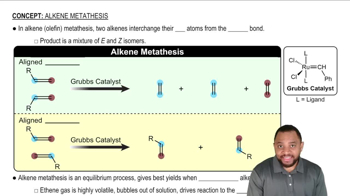
Alkenes, such as non-1-ene, can undergo various reactions including hydroboration-oxidation and ozonolysis. These reactions allow for the transformation of alkenes into alcohols or aldehydes, which are crucial for synthesizing compounds like octanal. Understanding the mechanisms and conditions of these reactions is essential for effective synthesis.
Recommended video:
2:09
Alkene Metathesis Concept 1

Oxidation and Reduction

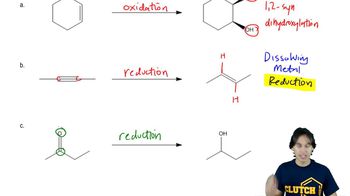
Oxidation and reduction reactions are fundamental in organic synthesis. In the context of synthesizing octanal, converting an alcohol to an aldehyde involves oxidation, while reducing a carboxylic acid to an aldehyde involves reduction. Familiarity with common oxidizing and reducing agents is necessary to navigate these transformations.
Recommended video:
Guided course
00:54
Distinguishing between Oxidation and Reduction

Functional Group Interconversion

Functional group interconversion refers to the process of transforming one functional group into another, which is vital in organic synthesis. For example, converting an alkene to an aldehyde requires specific reagents and conditions to achieve the desired functional group. Mastery of these conversions is key to synthesizing octanal from non-1-ene.
Recommended video:
Guided course
02:36
Identifying Functional Groups