Ch. 19 - Amines
Wade - Organic Chemistry 9th Edition
Wade9th EditionOrganic ChemistryISBN: 9780135213728Not the one you use?Change textbook
Chapter 19, Problem 21d

Give the products expected when the following tertiary amines are treated with a peroxyacid and heated.
(d) N-ethylpiperidine

Verified step by step guidance
1
Identify the reaction type: The reaction involves a tertiary amine (N-ethylpiperidine) being treated with a peroxyacid. This is a Cope elimination reaction, which occurs when an amine oxide undergoes thermal decomposition to form an alkene and a hydroxylamine.
Oxidation of the tertiary amine: Treat the tertiary amine (N-ethylpiperidine) with a peroxyacid (e.g., mCPBA). This step oxidizes the nitrogen atom in the amine to form an amine oxide. The structure of the amine oxide will have a positively charged nitrogen and a negatively charged oxygen.
Analyze the structure of the amine oxide: The amine oxide will have a β-hydrogen (a hydrogen atom on the carbon adjacent to the nitrogen). This β-hydrogen is crucial for the elimination step.
Perform the Cope elimination: Upon heating, the amine oxide undergoes a concerted elimination reaction. The β-hydrogen is removed, and a double bond forms between the α- and β-carbons, while the nitrogen-oxygen bond breaks to form a hydroxylamine.
Determine the final products: The products of the reaction will be an alkene (formed by the elimination) and a hydroxylamine (derived from the amine oxide). For N-ethylpiperidine, the alkene will be a cyclic compound with a double bond in the piperidine ring, and the hydroxylamine will retain the ethyl group.

Verified video answer for a similar problem:

This video solution was recommended by our tutors as helpful for the problem above.
Video duration:
5m
Was this helpful?

Key Concepts

Here are the essential concepts you must grasp in order to answer the question correctly.

Tertiary Amines

Tertiary amines are organic compounds that contain a nitrogen atom bonded to three carbon-containing groups. They are characterized by their ability to act as nucleophiles due to the lone pair of electrons on the nitrogen. In reactions, tertiary amines can undergo various transformations, including oxidation and acylation, which are relevant when discussing their behavior with peroxyacids.
Recommended video:
Guided course
01:57
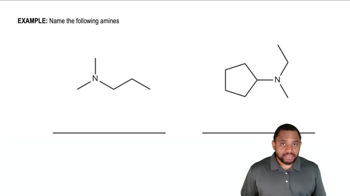
Naming Secondary and Tertiary Amines

Peroxyacids

Peroxyacids, also known as peracids, are organic compounds that contain a peroxy group (-O-O-) bonded to a carbon atom. They are strong oxidizing agents and can react with amines to form N-oxides or other oxidized products. Understanding the reactivity of peroxyacids is crucial for predicting the products formed when they interact with tertiary amines like N-ethylpiperidine.
Recommended video:
Guided course
04:15
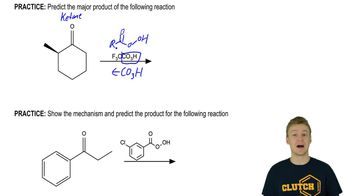
Predict The product:

Oxidation Reactions

Oxidation reactions involve the loss of electrons or an increase in oxidation state by a molecule. In the context of tertiary amines reacting with peroxyacids, oxidation can lead to the formation of N-oxides, which are stable products resulting from the addition of an oxygen atom to the nitrogen. Recognizing the nature of these reactions helps in predicting the expected products when heating tertiary amines with peroxyacids.
Recommended video:
Guided course
03:20
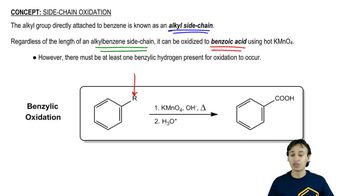
Benzylic Oxidation